
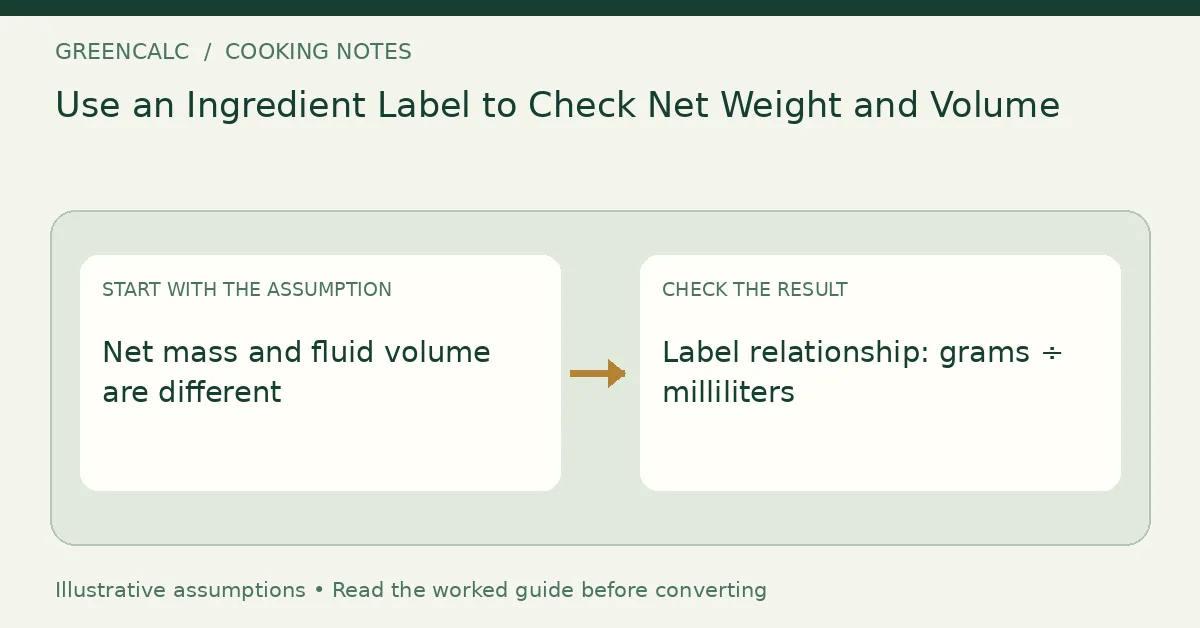
Original educational diagram for Use an Ingredient Label to Check Net Weight and Volume. Values are illustrative and use the assumptions explained in the article.
Read the quantity rather than the package shape
A container may state net mass, fluid volume or both. Grams describe mass and milliliters describe volume. A tall bottle does not establish either value, because the package has its own weight and may contain headspace. Read the net quantity and the units. Do not enter a bottle's total weighed mass as the ingredient mass without accounting for the container.
Derive a density only from comparable quantities
If a label or verified product specification gives 300 grams for 250 milliliters of the same ingredient state, the implied relationship is 1.2 grams per milliliter. Entering that density would convert 50 milliliters to 60 grams. Treat these as an illustrative calculation. Rounded label values, different serving definitions and temperature assumptions can limit the accuracy of a density inferred this way.
Separate fluid ounces from scale ounces
US fluid ounces are a volume measure, while ounces on a scale are ordinarily a mass measure. Do not divide one by the other without first putting the numbers into compatible units. For recipe work, convert fluid volume to milliliters and mass to grams, then calculate the density relationship. If the label does not supply a reliable pair of values, weigh a measured volume or use an appropriate product specification instead.
Work through your own quantities with the ml to Grams Calculator. Check the ingredient basis or conversion convention in the form before using its result.
Related kitchen guidance
Continue with Reading Metric and US Recipes Without Mixing Units. Explore the Cooking converters collection in Food calculators, or browse GreenCalc for other subjects.
For a different part of this task, read 100 mL of Water, Oil and Honey: Compare the Masses.
By GreenCalc · Updated 2026-11-03