
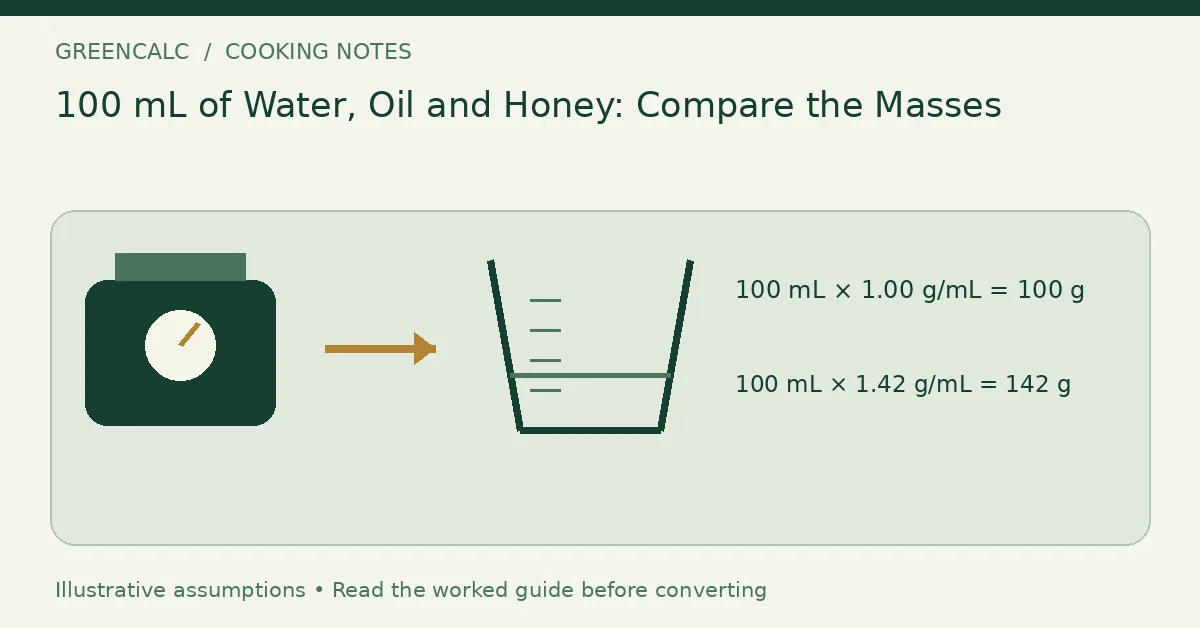
Original educational diagram for 100 mL of Water, Oil and Honey: Compare the Masses. Values are illustrative and use the assumptions explained in the article.
Multiply the shared volume by the right density
The calculation is mass in grams equals volume in milliliters multiplied by density in grams per milliliter. At a kitchen approximation of one gram per milliliter, 100 milliliters of water gives 100 grams. With an illustrative density of 1.42 grams per milliliter, 100 milliliters gives 142 grams. The second density may describe a honey example, but it is not a universal value for every jar.
Treat liquid density as a product-specific input
An oil example at 0.92 grams per milliliter gives 92 grams for 100 milliliters. Oil type and temperature can affect the actual value. Choose a credible product value or make a direct measurement when precision matters. The tool deliberately exposes the density field so a remembered water relationship cannot silently become the assumption for every ingredient.
Keep the reverse calculation in view
To recover volume from mass, divide grams by the same density. Thus 142 grams at 1.42 grams per milliliter corresponds to 100 milliliters. Reversing with a different density changes the model, not just the direction. If your original ingredient is a powder, a bulk-density estimate also depends on packing and air spaces; it should not be confused with the density of a solid piece of that material.
Work through your own quantities with the ml to Grams Calculator. Check the ingredient basis or conversion convention in the form before using its result.
Related kitchen guidance
Continue with Why a Cup of Flour and a Cup of Sugar Weigh Differently. Explore the Cooking converters collection in Food calculators, or browse GreenCalc for other subjects.
For a different part of this task, read Use an Ingredient Label to Check Net Weight and Volume.
By GreenCalc · Updated 2026-11-03