
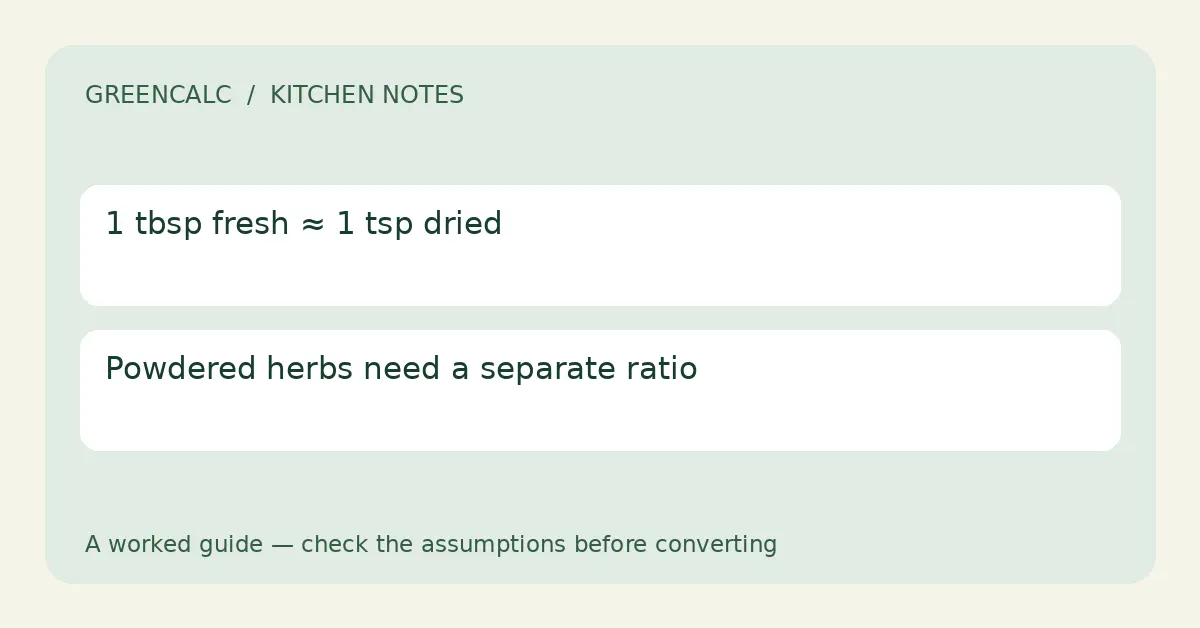
Original visual accompanying the guide: Fresh, Dried and Powdered Herbs: Three Different Measures
Use the general ratio as a starting point
Penn State Extension gives a general equivalence of one tablespoon fresh herbs, one teaspoon dried herbs, or a quarter teaspoon powdered herb. The familiar fresh-to-dried ratio is therefore three to one by volume. It is a substitution guide, not a measured guarantee of identical flavor in every herb or recipe.
Do not put powdered herbs into the dried-leaf setting
Powdered and dried leafy herbs have different particle sizes and practical strengths. If converting between fresh and powdered under the general guide, the volume ratio is twelve to one rather than three to one. Enter a ratio deliberately and keep the same unit on both sides. The tool does not automatically identify the grind from the ingredient name.
Respect the recipe's purpose
Fresh leaves can supply appearance, texture and a finishing aroma that dried herbs do not recreate. In a long-cooked dish, dried herbs may fit the method; for a fresh garnish, a numeric substitution may be unsuitable. Start cautiously and taste when safe. A recipe built around a large amount of fresh herbs may need a different ingredient choice rather than a direct conversion.
Work out your quantity
Use the Fresh to Dry Herb Conversion with the assumptions described above. Browse Food calculators for another kitchen conversion, or visit GreenCalc for the full calculator library.
Related guide: Adjust Herb Seasoning for Storage Age and Cooking Time.
More cooking conversions
By GreenCalc · Updated 2026-11-03