
Original visual accompanying the guide: Air Fryer Batch Size: Why a Correct Timer Can Still Fail
Give moving air a path
A tightly packed basket changes heat transfer. Pieces that touch can trap moisture and brown unevenly, so the same time and temperature may behave differently in two batches. Follow your appliance's loading guidance. If cooking several batches, keep their size consistent and check each batch; a warmed appliance can affect later batches.
Measure the part that cooks slowest
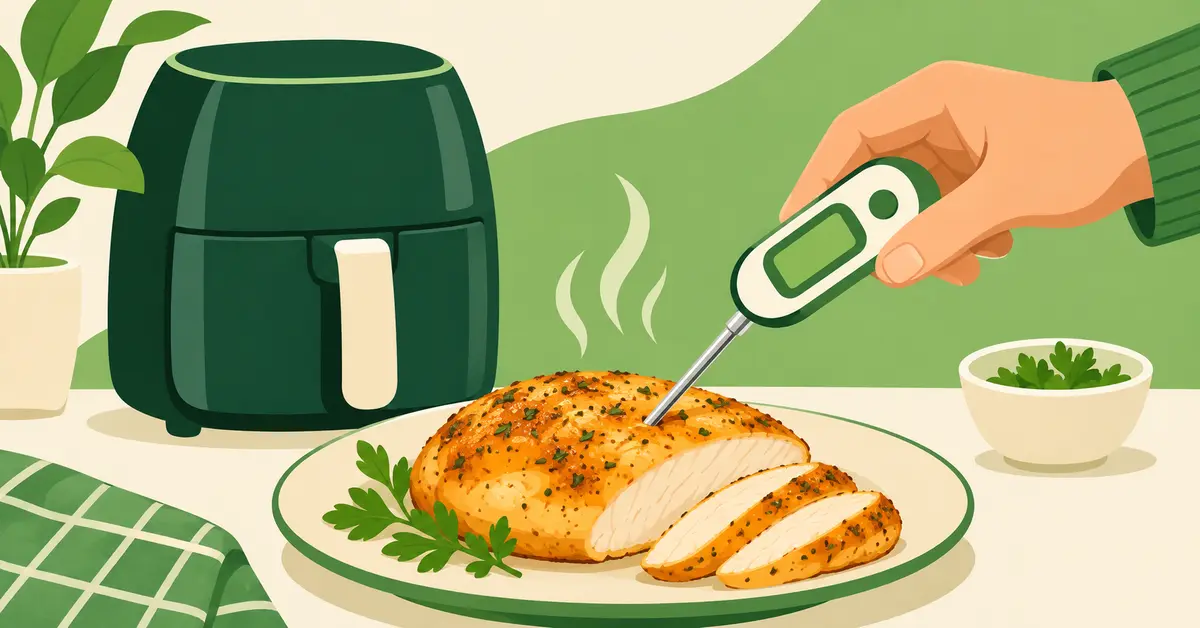
For meat and poultry, use a food thermometer at the appropriate location and follow the safe minimum internal temperature for that food. Do not infer internal temperature from a crisp exterior. FoodSafety.gov lists poultry at 165 °F, while whole cuts of beef, pork, veal and lamb use 145 °F plus a three-minute rest. Ground meats have different guidance.
Use a trial log instead of repeated guessing
Write down food weight, approximate thickness, whether it was frozen, basket loading, setting, and measured finish temperature. Change only one condition on the next attempt. A conversion tool supplies a starting estimate; your records explain why the estimate changes. Reheating leftovers and cooking raw food are separate tasks, so do not reuse one record as proof for the other.
Work out your quantity
Use the Air Fryer Calculator with the assumptions described above. Browse Food calculators for another kitchen conversion, or visit GreenCalc for the full calculator library.
Related guide: Oven to Air Fryer: Choose Your First Time and Temperature.
By GreenCalc · Updated 2026-11-03