
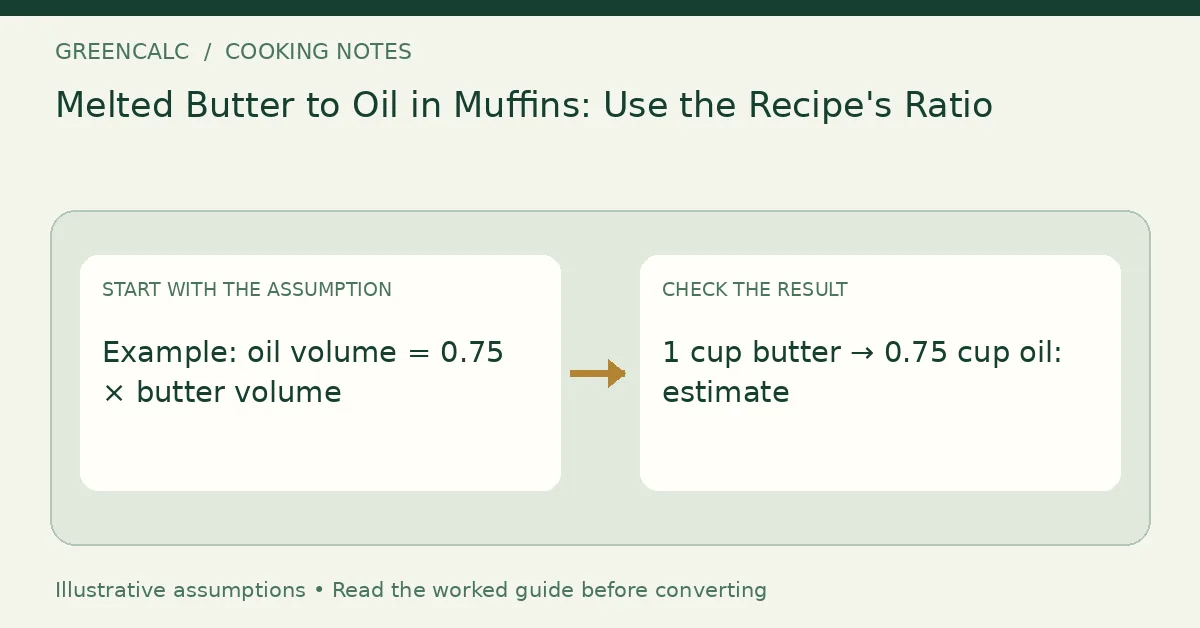
Original educational diagram for Melted Butter to Oil in Muffins: Use the Recipe's Ratio. Values are illustrative and use the assumptions explained in the article.
Use a substitution rule only where the method fits
A muffin recipe that mixes melted butter into wet ingredients has a different method from one that creams solid butter with sugar. Even in a melted-butter recipe, an oil substitution can change texture, flavor and the balance of water and fat. Prefer a tested variation from the recipe author. The calculator's default ratio is a planning assumption that you can edit, not a promise that the result will bake identically.
Keep both sides in one volume unit
With a chosen oil-to-butter volume ratio of 0.75, one cup of butter corresponds to three-quarters of a cup of oil. Half a cup of butter corresponds to three-eighths of a cup of oil. The same ratio can be applied to milliliters if both input and output use milliliters. Do not enter grams in a field labeled as volume and assume that the answer is still valid.
Record the test batch before scaling up
Make a small batch when changing a recipe, and note the oil type, chosen ratio, mixing method and baked result. Do not alter several other ingredients at the same time if you want to understand the substitution's effect. If the recipe depends on butter flavor or a specific texture, the best solution may be a tested oil-based recipe rather than further arithmetic on the original ingredient list.
Work through your own quantities with the Oil to Butter Conversion. Check the ingredient basis or conversion convention in the form before using its result.
Related kitchen guidance
Continue with A US Stick of Butter in Grams, Cups and Tablespoons. Explore the Cooking converters collection in Food calculators, or browse GreenCalc for other subjects.
For a different part of this task, read Why a Creamed-Butter Cake Cannot Be Fixed by One Oil Ratio.
By GreenCalc · Updated 2026-11-03