
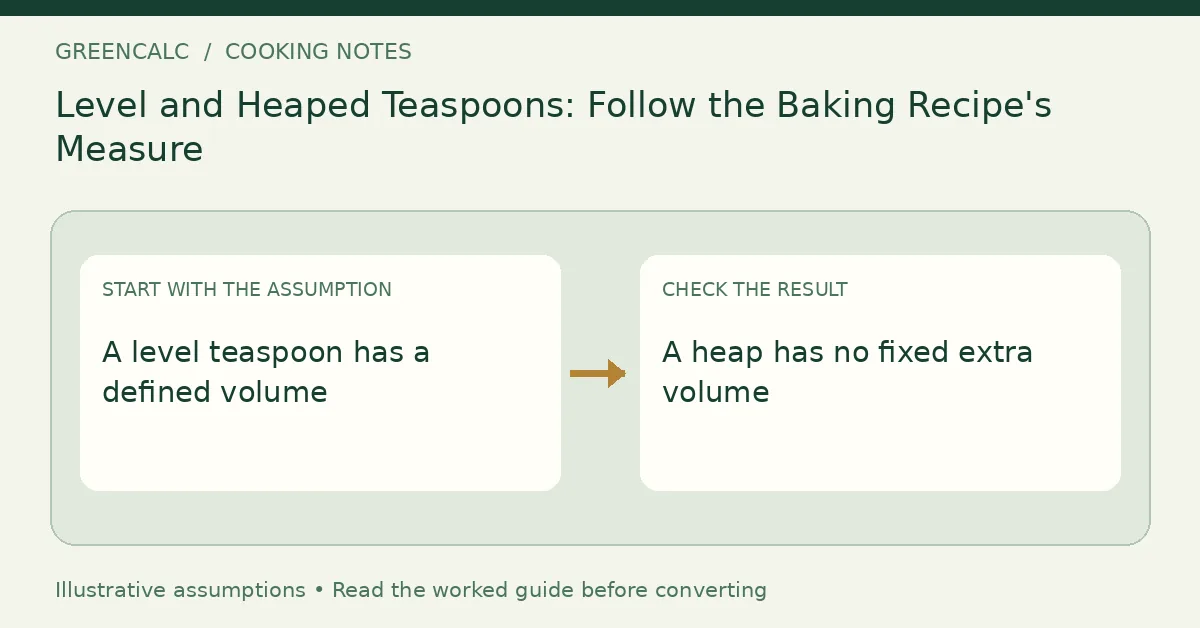
Original educational diagram for Level and Heaped Teaspoons: Follow the Baking Recipe's Measure. Values are illustrative and use the assumptions explained in the article.
A defined spoon does not define a heap
A measuring teaspoon has a nominal volume, but the mound above its rim has no universal size. Its shape depends on the ingredient, spoon and handling. A grams-to-teaspoons result assumes the stated measuring convention. It cannot infer how many grams your heaped teaspoon will hold or turn an undefined heap into a precise volume.
Use the ingredient's own weight relationship
The tool's baking-powder example uses four grams per US teaspoon, derived from its reference basis. Baking soda has a different preset. Product and recipe instructions can differ, so use their specified values when available. A larger spoon count does not tell you that an ingredient is weaker, nor does an equal gram amount make two leaveners function the same way.
Match the recipe before making an adjustment
If a recipe says level, level the spoon using an appropriate straight edge without compressing the ingredient unless instructed. If it says heaped but also provides grams, the mass is a clearer target. If an old recipe gives no mass, recognize the uncertainty rather than hiding it behind a decimal result. Keep a note of the method that worked for that recipe so a later batch can repeat it.
Work through your own quantities with the Grams to Teaspoons Converter. Check the ingredient basis or conversion convention in the form before using its result.
Related kitchen guidance
Continue with US Cups, Tablespoons and Teaspoons: A Practical Conversion Guide. Explore the Cooking converters collection in Food calculators, or browse GreenCalc for other subjects.
For a different part of this task, read Small Baking Quantities: Why Early Rounding Changes the Recipe.
By GreenCalc · Updated 2026-11-03