
Original editorial illustration for From Harvest to Kitchen: Track Fresh Weight, Dry Matter and Recipe Units
Keep the harvested product and the recipe ingredient distinct
A harvest record may describe fresh field mass, while a recipe may specify a prepared ingredient in grams, cups or spoons. Cleaning, trimming and preparation can change the quantity and its measuring convention. Record the state of the material instead of assuming that a field kilogram and a recipe kilogram always refer to an identical usable ingredient.
Mass-to-volume needs an ingredient basis
Grams and pounds describe mass; cups, spoons and milliliters describe volume. Converting between them requires a relevant ingredient weight or density. The water relationship is not a universal conversion for flour, oil or honey. Keep the chosen cup and spoon standards explicit when bringing a measurement from a field record into a kitchen worksheet.
Separate a measured quantity from an assumed usable share
A marketable or usable fraction can help describe an entered scenario, but it is not discovered by the calculator. Moisture corrections also answer a different question from removing damaged or unwanted parts. The following examples connect records while preserving these distinctions; they are not yield guarantees, food-quality assessments or instructions for a particular diet.
Start in Biology calculators for the field and measurement tools. This workflow also distinguishes questions handled in Food calculators, Conversion calculators. Follow the quantity and its definition rather than assuming that a shared unit makes different models interchangeable.
Worked case 1: Vegetable Yield Calculator
This harvest scenario expands a defined sample to a larger crop area, then applies an assumed marketable share. The two stages should remain visible. A single selected basket without a represented area would not support the same field extrapolation.
Calculate this scenario with Vegetable Yield Calculator using the following stated inputs.
| Input definition | Illustrative value |
|---|---|
| Represented harvested sample area (m²) | 4 |
| Harvest mass from that sample and stated period (kg) | 8 |
| Crop area extrapolated (m²) | 50 |
| Assumed marketable fraction (%) | 80 |
| Calculated quantity | Result | Unit |
|---|---|---|
| Observed harvest density | 2 | kg/m² |
| Extrapolated total mass | 100 | kg |
| Mass after entered marketable share | 80 | kg |
The usable result is conditional on the fraction supplied. A later change in sorting criteria should not be described as a measured change in growth. Preserve the observation period and whether the mass was taken before or after preparation.
Worked case 2: Grain Conversion Calculator
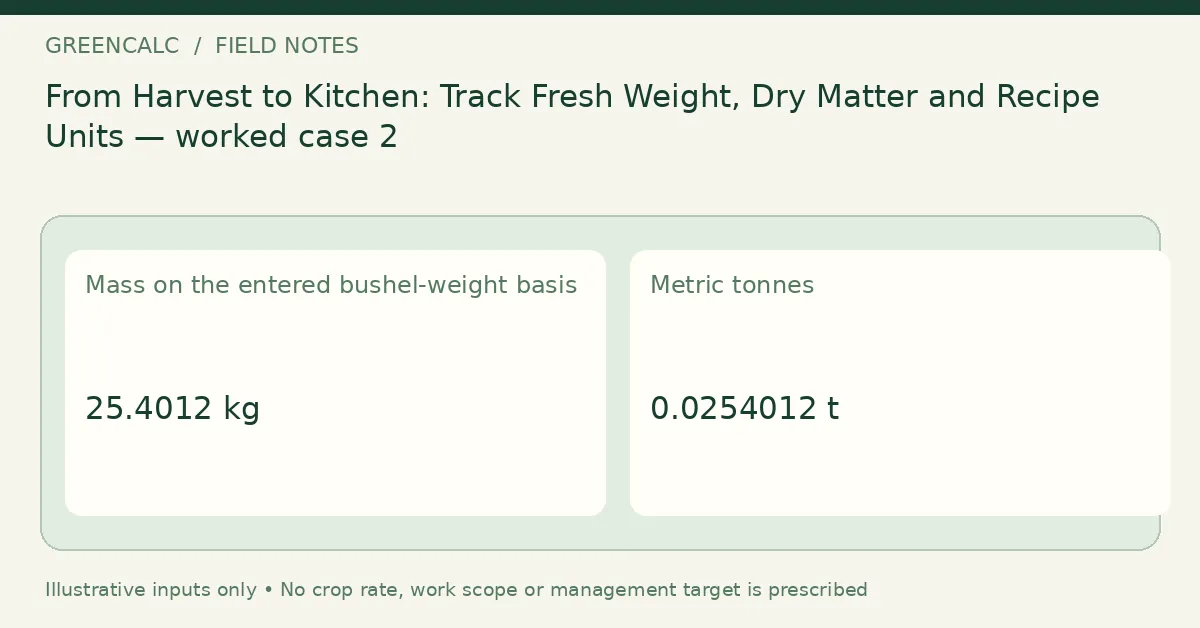
A grain bushel enters the workflow with a defined weight basis rather than as an ordinary kitchen cup. The conversion can produce kilograms for a record, but it does not supply a cup weight for the ingredient after milling or another preparation step.
Calculate this scenario with Grain Conversion Calculator using the following stated inputs.
| Input definition | Illustrative value |
|---|---|
| Quantity in the selected starting unit | 1 |
| Convert | bu-to-kg |
| Defined commodity or measured weight (lb per US bushel) | 56 |
| Calculated quantity | Result | Unit |
|---|---|---|
| Mass on the entered bushel-weight basis | 25.4012 | kg |
| Metric tonnes | 0.0254012 | t |
Keep commodity conventions, physical storage volume and recipe volume separate. The same word for a crop does not make all those relationships interchangeable. A moisture adjustment or a product-specific density would be an additional piece of information.
The Grain mass and accounting-basis context explains grain-accounting context. Those conventions should not be reused as a kitchen ingredient’s cup-weight assumption.
Worked case 3: Grams to Cups Converter
A flour example demonstrates the need for an ingredient-specific grams-per-cup value. This is a new recipe ingredient basis, not a conversion factor inherited from the harvested grain example. The selected cup standard is also part of the calculation.
Calculate this scenario with Grams to Cups Converter using the following stated inputs.
| Input definition | Illustrative value |
|---|---|
| Ingredient mass | 250 g |
| Ingredient basis | 120 g per US cup |
| Cup standard | US |
| Calculated quantity | Result | Unit |
|---|---|---|
| Converted quantity | 2.08333 | US cups |
When a recipe provides its own gram quantity, using it directly avoids introducing a volume estimate. If volume is needed, retain the chosen factor and preparation method. A similar-looking cup result for another ingredient is not evidence that it has the same mass.
The Ingredient-specific recipe weight references is an ingredient-specific reference, not a single mass assigned to every cup. Prefer a recipe’s own gram measurements when available.
For a kitchen example with one declared ingredient basis, 250 g of Flour: Work Out US and Metric Cup Measures follows a flour mass into US and metric cup measures. Its flour assumption must not be transferred to vegetables or another packed ingredient.
Worked case 4: Grams to Tablespoons Converter
A sticky-ingredient example uses honey on a stated US-spoon basis. The volume estimate describes the ingredient quantity, not how much remains on a utensil during transfer. A different tablespoon standard would produce a different spoon count.
Calculate this scenario with Grams to Tablespoons Converter using the following stated inputs.
| Input definition | Illustrative value |
|---|---|
| Ingredient mass | 42 g |
| Ingredient basis | 336 g per US cup |
| Spoon standard | US tablespoon |
| Calculated quantity | Result | Unit |
|---|---|---|
| Converted quantity | 2 | US tablespoons |
Use a product or recipe relationship appropriate to the ingredient. For careful measurement, a scale can avoid repeated transfers through sticky containers. The calculation does not make a heaped spoon or an ordinary eating spoon into a defined volume unit.
Worked case 5: ml to Grams Calculator
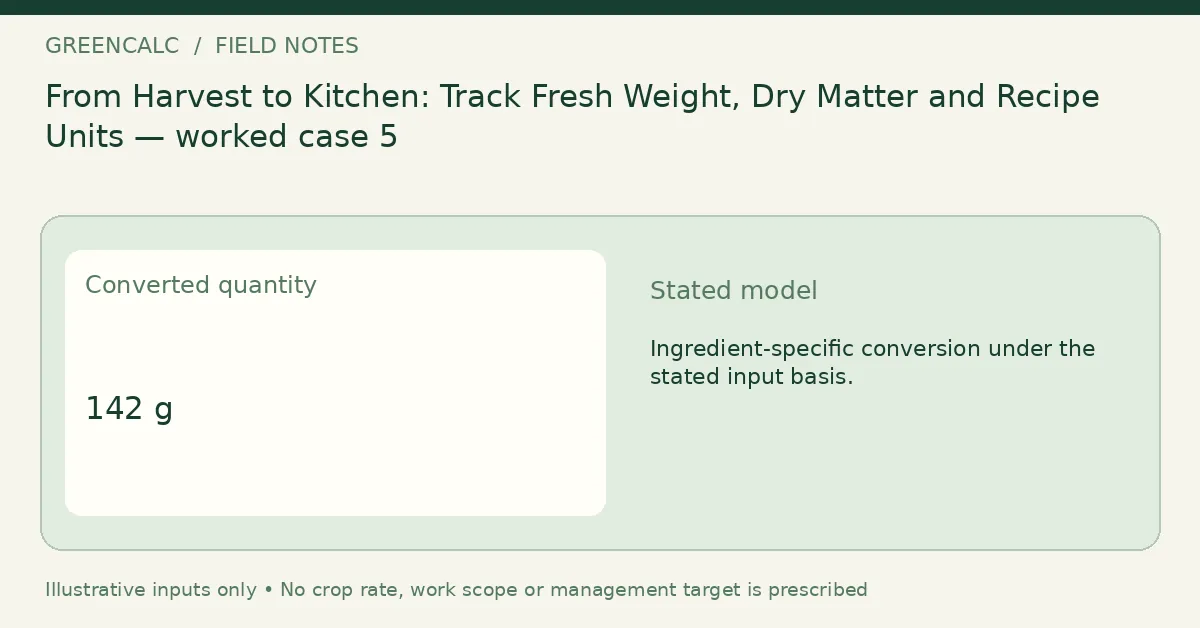
The liquid-volume example supplies an explicit density instead of assuming that milliliters always equal grams. Its numeric density is illustrative and must fit the actual product and condition. Entered water-like defaults should not silently become the basis for every liquid.
Calculate this scenario with ml to Grams Calculator using the following stated inputs.
| Input definition | Illustrative value |
|---|---|
| Ingredient volume | 100 mL |
| Density | 1.42 g/mL |
| Calculated quantity | Result | Unit |
|---|---|---|
| Converted quantity | 142 | g |
Reversing the calculation requires the same density assumption. A different product, temperature or bulk-packing state can require a new measurement. Keep label quantities and net-container definitions clear before deriving a density from a mass-and-volume pair.
Worked case 6: Pounds to Cups Converter
A package mass expressed in pounds can be converted through grams into a chosen ingredient cup basis. That is a different workflow from dividing a bag into visually equal portions. The conversion does not determine how firmly the ingredient is packed into a cup.
Calculate this scenario with Pounds to Cups Converter using the following stated inputs.
| Input definition | Illustrative value |
|---|---|
| Ingredient mass | 1 lb |
| Ingredient basis | 120 g per US cup |
| Cup standard | US |
| Calculated quantity | Result | Unit |
|---|---|---|
| Converted quantity | 3.77994 | US cups |
Retain both the mass unit and the ingredient reference. If a recipe uses a metric cup or another ingredient form, select the matching basis rather than replacing the result’s unit label after calculation. Rounding belongs at the final practical measurement step.
Carry the original mass through the conversion sheet
A one-pound ingredient mass is four hundred fifty-three-point-five-nine-two-three-seven grams. At a flour reference of one hundred twenty grams per US cup, that is about three-point-seven-eight cups. Rounding it to four cups would correspond to four hundred eighty grams under the same reference, adding about twenty-six-point-four grams. That difference is a rounding choice, not a property of the pound unit.
A different cup standard or ingredient factor changes the volume comparison. In the two-hundred-fifty-gram flour example, a US-cup count and a metric-cup count differ because their containers have different volumes. The original mass remains two hundred fifty grams. Changing the unit label without recalculating would lose that relationship.
Approximate ingredient references can also be rounded differently. A weight-per-tablespoon reference and a separately rounded liquid-density reference may not reverse to identical final digits. Keep the basis used for a particular calculation instead of forcing every chart to agree by further rounding. For precise recipe work, use the original stated mass directly when practical. For a harvest worksheet, preserve whether the mass describes whole, cleaned or prepared produce; a unit conversion cannot supply an unknown preparation loss or make a general cup factor fit every ingredient.
Check the record before using it elsewhere
Use the following questions to audit this particular workflow. An unanswered question is an input or interpretation issue; it should not be hidden by rounding the output or choosing a result that resembles the expected answer.
- What preparation state does each mass describe?
- Is usable share an observation or an assumption?
- Does the bushel figure use a stated commodity weight convention?
- Which grams-per-cup value fits the actual recipe ingredient?
- Are cup and spoon standards identified?
- Is a liquid density product-specific rather than borrowed from water?
- Are container mass and net ingredient mass kept separate?
- Can the original record be recovered after converting and rounding?
Retain a revisable measurement sheet
Keep the original observations, the date and the input definitions alongside the calculated result. When a plan changes, record the new scenario separately instead of replacing the evidence behind an earlier estimate. A measured change, a revised assumption and a unit conversion are different events in the record.
Use Vegetable Yield Calculator for the main quantity in this workflow. For other subjects, return to GreenCalc; for a related calculation, begin with its own units, basis and limitations rather than transferring a result by name alone.
By GreenCalc · Updated 2026-11-06