
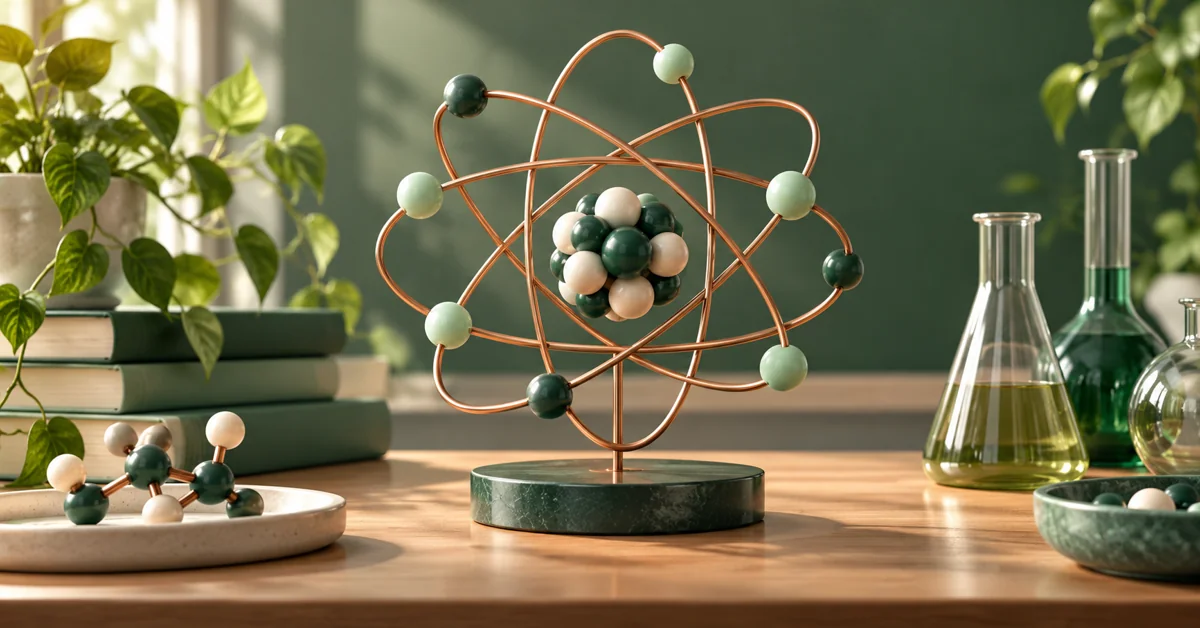
Conceptual model of an atom on an ivory chemistry desk. Original AI-generated editorial artwork produced for GreenCalc.
A sodium atom and a sodium ion contain the same number of protons. They differ in their electron counts. That distinction is the starting point for reading isotope notation without mixing up the nucleus and the electron cloud.
Three numbers describe three different things
The atomic number, Z, counts protons and identifies the element. The mass number, A, counts protons plus neutrons. The signed ionic charge, q, compares protons with electrons. These give three useful relationships: protons = Z, neutrons = A − Z, and electrons = Z − q.
Enter those values in the Atom Calculator to see all three particle counts together. A positive charge removes electrons from the neutral count; a negative charge adds them. The proton count does not change when an ordinary chemical ion forms.
Worked example: calcium-40 and its ion
Calcium has atomic number 20. Calcium-40 therefore has 20 protons and 40 − 20 = 20 neutrons. A neutral calcium-40 atom has 20 electrons. For Ca²⁺, use q = +2: the electron count becomes 20 − 2 = 18. The mass number remains 40.
For a sulfide ion with Z = 16, A = 32 and q = −2, the corresponding counts are 16 protons, 16 neutrons and 18 electrons. Write the subtraction as 16 − (−2), rather than dropping the negative sign.
Isotopes change the neutron count
Carbon-12 and carbon-14 both have six protons. Their neutron counts are six and eight. They are isotopes of carbon, not separate elements. Losing an electron would change their charge, but would not turn one isotope into the other.
The Atomic Mass Calculator connects nucleon counts with a classroom mass estimate. Read mass number versus atomic mass before treating an integer isotope label as a precise measured mass.
A short checking routine
- Use a whole-number mass number for one isotope, rather than the decimal atomic weight printed on a periodic table.
- Keep the sign of the ionic charge.
- Reject A smaller than Z: that would require a negative neutron count.
- Check that q does not exceed Z, which would produce a negative electron count.
A mathematically valid combination is not evidence that the isotope or ion exists in nature. For measured isotope data, consult the references below.
What to study next
Particle counts tell you how many electrons an atom has. Their distribution among subshells is a separate question, covered by the Electron Configuration Calculator. Browse the Chemistry calculators to move from atomic structure to masses and bonding.
By GreenCalc · Updated 2026-10-21
Frequently asked questions
Does an ion have a different atomic number?
No. Ordinary ion formation changes electrons. Atomic number counts protons.
Can I enter a decimal mass number?
No. Mass number counts protons plus neutrons and is an integer.