
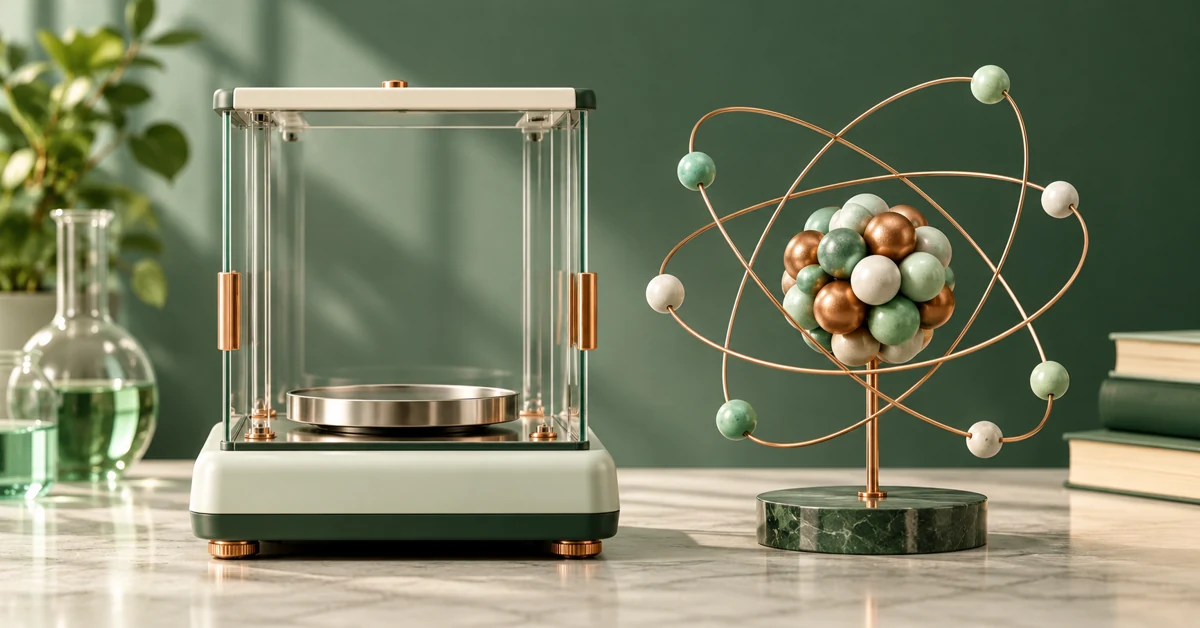
Laboratory balance and conceptual nucleus model illustrating mass measurement. Original AI-generated editorial artwork produced for GreenCalc.
The label carbon-12 gives a nucleon count. The familiar decimal number on a periodic table usually describes an average. Both concern mass, but they answer different questions. Recognising which quantity a problem supplies is often more useful than doing the arithmetic quickly.
Mass number is an integer count
For an isotope with Z protons and N neutrons, A = Z + N. Six protons and eight neutrons give A = 14. The element is carbon because its proton count is six; the neutron count identifies the isotope.
The Atomic Mass Calculator reports A and uses A u as an explicitly approximate atomic mass. For A = 14, this gives approximately 14 u per atom, or 2.324754696488 × 10⁻²⁶ kg. The conversion uses 1 u ≈ 1.66053906892 × 10⁻²⁷ kg.
Why the estimate is not an isotope-mass database
A bound atom does not weigh exactly as much as the sum of isolated protons, neutrons and electrons. Binding energy contributes to the mass difference. Proton and neutron masses also differ, so the total number of nucleons is not enough to determine a precise atomic mass.
Carbon-12 is the defining reference: one unified atomic mass unit is one twelfth of the mass of a free, neutral carbon-12 atom in its ground state and at rest. Other isotope masses need measured or evaluated data. Rounding an isotope mass to an integer can be useful in an introductory exercise, but the rounded value should not acquire extra precision merely because a calculator displays many digits.
Atomic weight answers another question
A sample containing multiple isotopes has a weighted mean atomic mass. The proportions matter. Two samples of the same element can have different isotope compositions, and some standard atomic weights are therefore expressed as intervals.
Use the Average Atomic Mass Calculator when isotope masses and abundances are supplied. The companion guide to isotope abundance and weighted averages shows why an ordinary arithmetic mean usually fails.
Choosing the right value for a calculation
- For counting neutrons, use A − Z and keep A as an integer.
- For a classroom estimate of one atom's mass, A u may be sufficient if the exercise permits it.
- For mass spectrometry or a precise isotope calculation, use evaluated isotope masses.
- For the average mass of atoms in a specified sample, use its isotope fractions.
The Atom Calculator helps recover the underlying particle counts. All three mass-related tools are grouped in the Chemistry category, so the assumptions can be checked before moving between them.
By GreenCalc · Updated 2026-10-21
Frequently asked questions
Is A u a measured isotope mass?
No. This tool uses a labelled classroom approximation; precise isotope masses require evaluated data.
How is mass converted from u to kg?
Multiply the value in u by approximately 1.66053906892 × 10⁻²⁷ kg/u.