
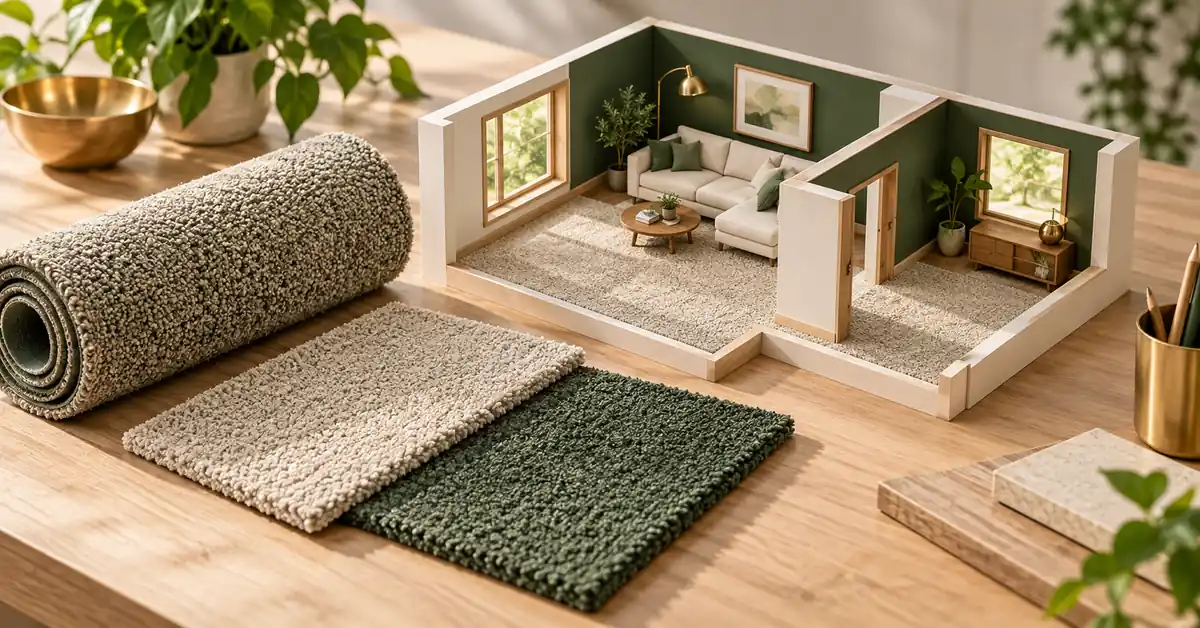
Carpet roll and cut pieces beside an L-shaped room model. Original AI-generated artwork produced for GreenCalc; the scene is not a measured construction drawing.
Net square yards describe the floor's area. A carpet order depends on the pieces cut from a roll of fixed width, including direction, seams, pattern alignment and the seller's length increments. An area total is a useful lower-bound check, but it is not a complete cutting layout.
Begin with both the floor plan and the roll width
Use the Square Yards Calculator to convert a checked area and compare area-based prices. Keep the roll width on a separate line. For a hypothetical 12-foot-wide roll, one linear yard of length supplies 12 × 3 = 36 square feet, or four square yards of material.
A plain 12-foot by 15-foot rectangular floor contains 180 square feet, or 20 square yards. If one 12-foot-wide by 15-foot-long cut is suitable for the installation, the geometric cut contains the same 20 square yards and uses five linear yards of roll length. Additional trimming or product requirements must still be specified.
See how a small second piece changes the order
Consider a floor assembled from a 12-foot by 10-foot main region and a separate 4-foot by 6-foot region. Assume the regions do not overlap. Their net area is 120 + 24 = 144 square feet, or 16 square yards.
If installation direction requires the smaller piece's 6-foot dimension to run along the roll length, the main cut uses 10 linear feet and the second cut uses another 6 linear feet. At a 12-foot roll width, the purchased rectangles total 12 × 16 = 192 square feet, or 21.333333 square yards, before any additional trim or selling increment.
| Quantity | Example value | What it describes |
|---|---|---|
| Net floor | 144 ft² / 16 yd² | Area to cover |
| Assumed roll width | 12 ft | Available material width |
| Direction-constrained cut length | 16 linear ft | Two cuts, 10 ft and 6 ft long |
| Purchased cut rectangles | 192 ft² / 21.333333 yd² | Material occupied on the roll |
Rotation may help, but it is not automatically allowed
If the smaller piece may rotate, a 6-foot-wide by 4-foot-long cut can fit within the same 12-foot roll width. The combined roll length in that simplified arrangement is then 14 feet, giving 168 square feet, or 18.666667 square yards. Whether that arrangement is acceptable depends on the product, pile direction, appearance, seams and installation instructions.
A calculator that merely adds a percentage to the net area cannot determine which orientation is suitable. Offcuts must be dimensioned pieces with a known direction. Their area alone does not prove they can fill the remaining floor.
Pattern repeats add another constraint
A patterned product can require additional length to match adjacent cuts. In a simplified example, if a 13-foot cut must use a whole number of 2-foot repeats and starts at an aligned phase, its length rounds to 14 feet. Real matching can involve both directions and a starting offset, so this illustration is not a universal order rule.
Obtain a layout appropriate to the actual product and the installer's seam plan. Keep pattern repeat, direction and any required trim written alongside the cut dimensions rather than hiding them in an unexplained waste factor.
Check the price against the sold unit
A quote per square yard of cut material is applied to the purchased cut quantity, while a quote per linear yard needs the selected roll length. The price-unit comparison guide shows how to normalise these bases without a ninefold or width-related error.
For pack-based products, use the separate flooring-carton worksheet. A whole-carton ceiling operation and a roll-cut arrangement are different purchasing problems, even when both begin with the same measured floor area.
Use the Construction calculator collection to follow the measurement workflow, or visit the GreenCalc home page for the complete tool directory.
By GreenCalc Editorial Team · Updated 2026-10-22
Frequently asked questions
Does a percentage allowance replace a roll cutting layout?
No. A suitable layout must respect roll width, piece dimensions, direction, seams and any pattern constraints.
Can every useful offcut be represented by its area alone?
No. Its actual dimensions and direction determine whether it can fill the required space.