
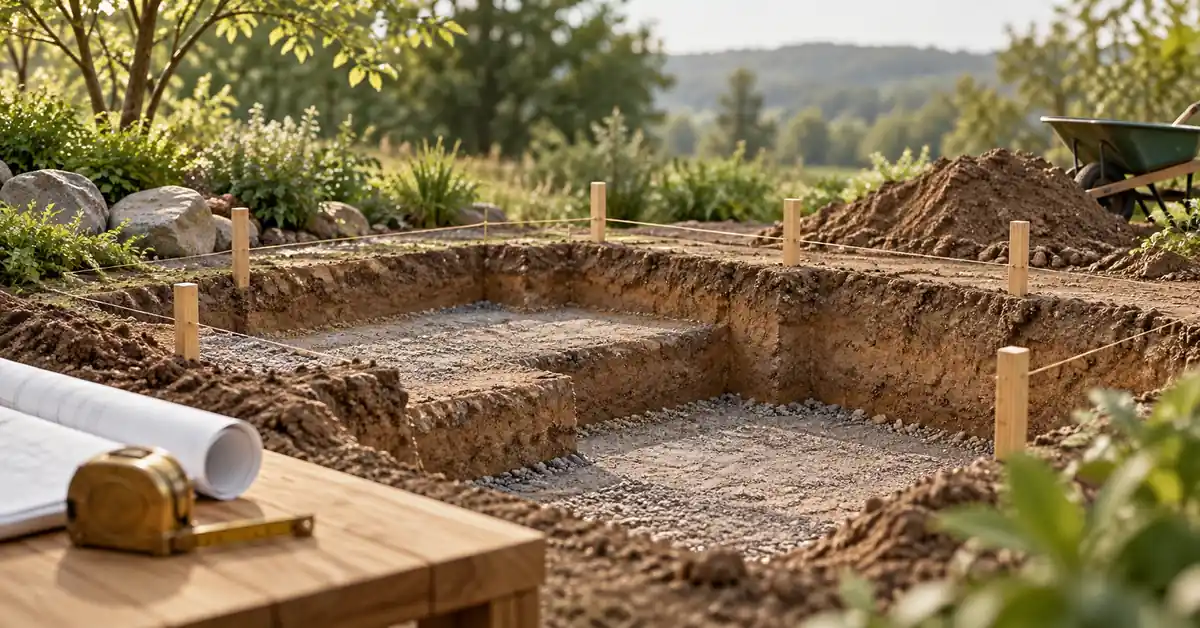
Excavation with separate depths and survey stakes. Original AI-generated artwork produced for GreenCalc; the scene is not a measured construction drawing.
For an area with different depths, calculate the volume of each zone and add the volumes. If you need one representative depth, weight each depth by its associated area. Averaging a shallow reading and a deep reading without considering their coverage can substantially misstate the total.
Keep depth paired with area
Suppose 80 square feet need a 2-inch layer and another 20 square feet need an 8-inch layer. Their individual volumes are 80 × 2 ÷ 324 = 0.493827 cubic yard and 20 × 8 ÷ 324 = 0.493827 cubic yard. The equal volumes arise because the larger shallow area and smaller deep area have the same area-depth product.
Enter each zone separately in the Square Feet to Cubic Yards Calculator with no allowance while establishing the net total. Adding them gives 0.987654 cubic yard. Keep the unrounded values for the sum, then round the displayed answer.
| Zone | Area | Depth | Area × depth |
|---|---|---|---|
| Shallow region | 80 ft² | 2 in | 160 ft²·in |
| Deep region | 20 ft² | 8 in | 160 ft²·in |
| Total | 100 ft² | Weighted depth: 3.2 in | 320 ft²·in |
See why the simple mean fails here
The arithmetic mean of the two depths is (2 + 8) ÷ 2 = 5 inches. Applying five inches to all 100 square feet produces 1.543210 cubic yards, rather than 0.987654. It gives the 20-square-foot deep zone the same influence as the 80-square-foot shallow zone.
The area-weighted mean is (80 × 2 + 20 × 8) ÷ 100 = 3.2 inches. Multiplying 100 square feet by that depth reproduces the zone total. This result depends on the areas and depths in this particular example; 3.2 inches is not a suggested general thickness.
A linear slope is a different geometry
If depth varies continuously and linearly from two inches to eight inches across a constant-width rectangular footprint, the mean of the end depths is five inches. In that special model, the five-inch mean correctly represents the whole footprint. That is not the same shape as two stepwise zones covering eighty and twenty percent of the area.
Write down the geometric assumption before choosing an averaging shortcut. End readings alone do not prove a linear slope. Ruts, local depressions, steps or a changing footprint width can require more measurements or a different volume model.
Make the measurement zones traceable
Sketch boundaries that can be identified again on site. Label each region with area, depth unit and a short note about what the depth represents. If you use a grid, record the grid spacing and how sample depths represent the cells. Narrow deep features can disappear in a coarse set of measurements, so inspect whether the sampling pattern captures them.
A quantity worksheet can show uncertainty without pretending the geometry is known exactly. Calculate a lower and upper scenario using plausible measured depths, keeping the zone areas fixed. The difference reveals how strongly depth uncertainty affects the order.
Apply contingency after the net sum
Once the net volume is established, add any chosen allowance as a separate decision. An allowance should not disguise an unresolved measurement problem. Adding ten percent to an overestimated five-inch mean does not correct its area weighting; it compounds the error.
Use the uniform-layer reference table only for a single representative thickness. The delivery and rounding guide handles supplier increments after the geometric total is known. For a garden-bed fill and bag count, the existing Soil Calculator remains the dedicated workflow rather than a duplicate of this construction-measurement guide.
Use the Construction calculator collection to follow the measurement workflow, or visit the GreenCalc home page for the complete tool directory.
By GreenCalc Editorial Team · Updated 2026-10-22
Frequently asked questions
Why can an unweighted mean of depth readings be misleading?
It gives each reading equal influence even when the readings represent different areas.
Can a percentage allowance repair an incorrect depth model?
No. Establish a defensible geometric or area-weighted volume before applying a separate contingency.