
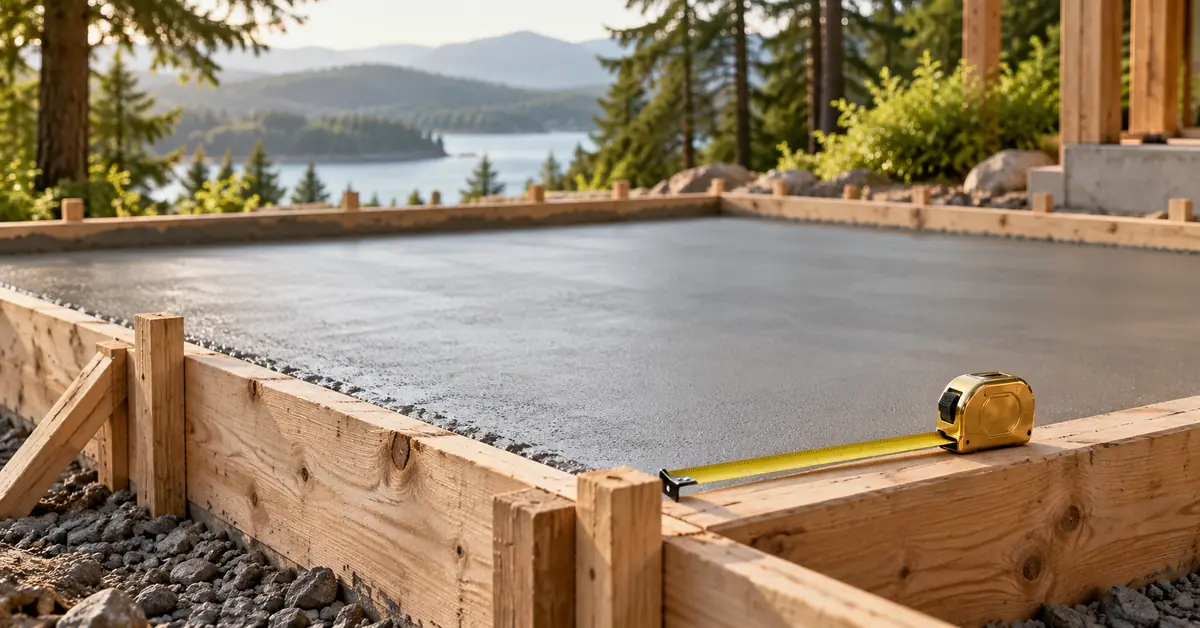
Uniform slab form with an unmarked tape measure beside the edge. Original AI-generated artwork produced for GreenCalc; the scene is not a measured construction drawing.
A slab volume needs both area and thickness. For square feet and inches, divide their product by 324 to obtain cubic yards. The number 324 combines the twelve inches in a foot with the twenty-seven cubic feet in a cubic yard. Area by itself cannot determine the amount of material.
Use a known area without reconstructing the footprint
If a checked plan already gives the project area, use the Square Feet to Cubic Yards Calculator. Enter the area and a uniform layer thickness, select their units, and calculate. This workflow avoids remeasuring the same footprint as a rectangle when the plan's area already accounts for corners or cutouts.
For 100 square feet at 4 inches thick, the volume is 100 × 4 ÷ 324 = 1.2345679 cubic yards. In cubic feet, the same calculation is 100 × (4 ÷ 12) = 33.333333. Dividing that answer by 27 gives the same yardage.
A reference table per 100 square feet
| Uniform thickness | Net ft³ per 100 ft² | Net yd³ per 100 ft² |
|---|---|---|
| 1 in | 8.333333 | 0.308642 |
| 2 in | 16.666667 | 0.617284 |
| 3 in | 25.000000 | 0.925926 |
| 4 in | 33.333333 | 1.234568 |
| 6 in | 50.000000 | 1.851852 |
| 8 in | 66.666667 | 2.469136 |
| 12 in | 100.000000 | 3.703704 |
These are geometric reference quantities, rounded for display. They do not recommend a construction thickness. Multiply an unrounded calculation by your actual area ratio; avoid building a large order by repeatedly adding already rounded table entries.
Scale the table carefully
A 540-square-foot area at 6 inches deep needs 540 × 6 ÷ 324 = 10 cubic yards. The table gives about 1.851852 yards per 100 square feet at that thickness, so multiplying by 5.4 provides a useful cross-check. A six-inch depth is half a foot, not six feet.
With a chosen 7% allowance, the planning scenario becomes 10.7 cubic yards. That allowance is an explicit input, not part of the conversion. A supplier's increment or minimum order can change the amount purchased again. Keep the geometric ten-yard result visible on the worksheet.
Recognise the three common unit errors
- Using 27 with thickness still in inches produces a volume twelve times too large.
- Dividing by 9 converts square feet to square yards; it does not convert a volume.
- Using a length of one yard as if it were one cubic yard omits two dimensions.
For metric measurements, multiply area in square meters by depth in meters to get cubic meters, then divide by 0.764554857984 to obtain cubic yards. The calculator performs that conversion from its selected units. Unit changes preserve the entered physical measurement rather than silently reinterpreting the same number.
When a single thickness is not enough
A uniformly thick layer on a flat base is the simple case. Thickened edges, separate pads, depressions and sloping surfaces may need separate volumes. A stated average thickness is defensible only when it represents the area weighting of the whole footprint.
The uneven-depth zoning guide shows how a small deep region can distort an unweighted average. If the dimensions of different shapes are your starting point instead of a known area, use the Cubic Yard Calculator. If the area still needs measuring, start with the Square Footage Calculator.
Keep the specification and estimate connected
Record the plan revision, net area, specified thickness, deductions and chosen allowance with the result. Check whether the supplier quote includes delivery or minimum-load charges. The arithmetic supports a quantity estimate; it does not select a structural design, approve a subbase or establish compliance with a project specification.
Use the Construction calculator collection to follow the measurement workflow, or visit the GreenCalc home page for the complete tool directory.
By GreenCalc Editorial Team · Updated 2026-10-22
Frequently asked questions
Does a thickness table recommend a structural slab design?
No. The table contains geometric quantities only; the project specification determines appropriate design.
What does 540 square feet at six inches equal?
It equals 270 cubic feet, or exactly 10 cubic yards before any allowance.