
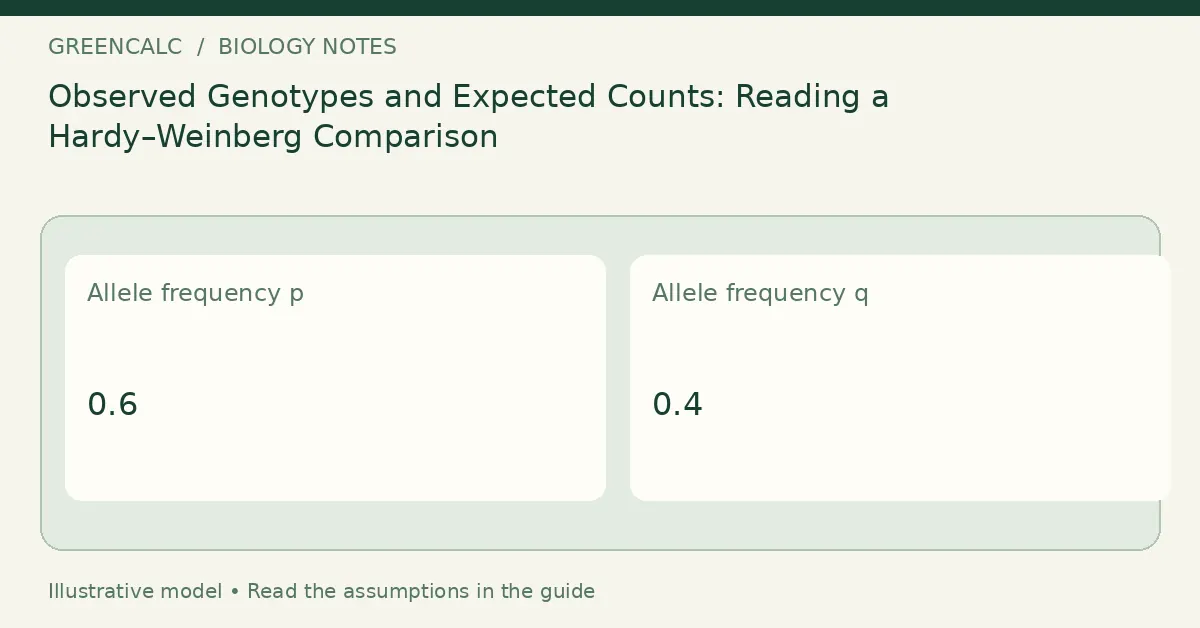
Original instructional diagram for Observed Genotypes and Expected Counts: Reading a Hardy–Weinberg Comparison. Values, when shown, are illustrative; clinical images do not recommend a dose.
Count genotypes before estimating alleles
Each individual contributes two alleles at this diploid locus. A heterozygote contributes one copy of each allele, while a homozygote contributes two of one kind. Use a consistent population and whole genotype counts before computing the allele proportions.
Use Hardy-Weinberg Equilibrium Calculator to work through these inputs while keeping the displayed assumptions in view.
Expected counts are not a test result
Agreement or disagreement between observed and expected counts needs statistical and biological context. Small samples, related individuals and sampling choices can affect the comparison. The displayed expected counts do not by themselves prove equilibrium or identify a reason for a departure.
This question belongs to the Genetics calculators group within Biology calculators.
Read the calculation on its stated basis
p = (2AA + Aa)/(2N), q = 1 − p; expected genotype counts are p²N, 2pqN and q²N.
A model is useful only within its assumptions. The result describes the input population or cross; it does not supply missing biological information or replace an appropriate genetic assessment.
Keep related questions separate
Allele Frequency Calculator addresses a related part of the measurement or interpretation task. Check its own method before carrying a value from one tool to the other.
For a related perspective, read When Recessive Disease Prevalence Can Represent q² — and When It Cannot.
For tools in other subjects, return to GreenCalc. Keep the calculator result with its assumptions rather than using a link or a matching unit as evidence that two models are interchangeable.
By GreenCalc · Updated 2026-11-05