
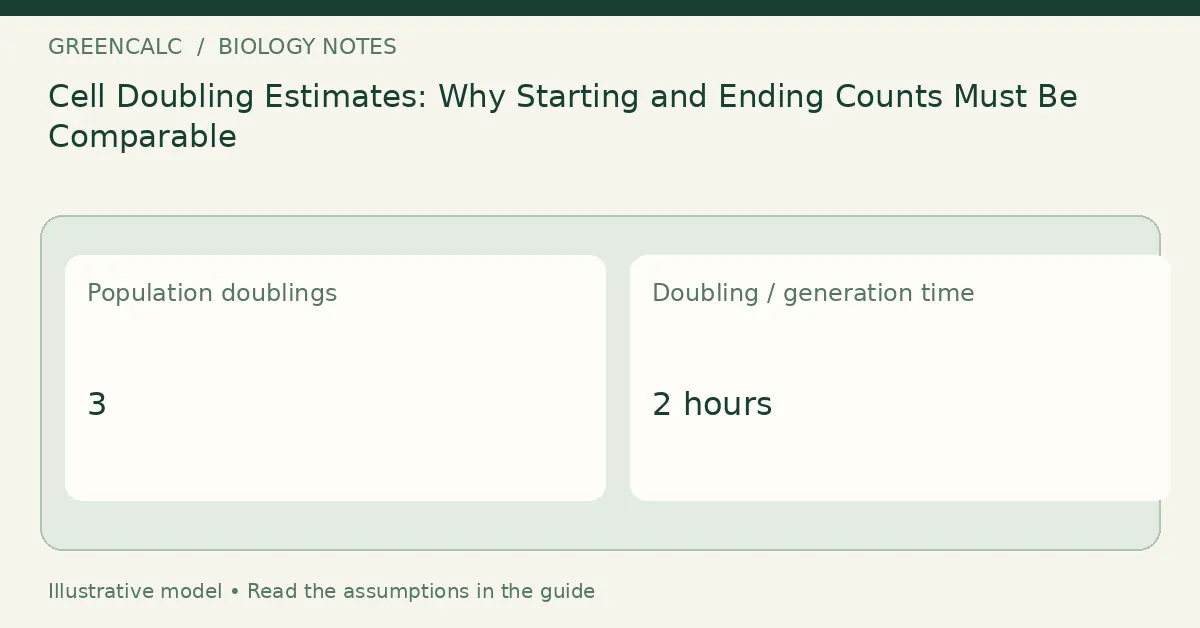
Original instructional diagram for Cell Doubling Estimates: Why Starting and Ending Counts Must Be Comparable. Values, when shown, are illustrative; clinical images do not recommend a dose.
Use the same counting definition twice
A viable-cell count, a total-cell count and an instrument signal need not follow identical changes. Keep the definition of the population consistent across the two time points. An arithmetic ratio cannot correct a switch in what the measurement represents.
Use Cell Doubling Time Calculator to work through these inputs while keeping the displayed assumptions in view.
Keep the estimate tied to elapsed time
Changing hours to minutes changes the numerical doubling time even though the underlying growth is the same. Record elapsed time directly rather than inferring it from rounded calendar labels. A decreasing population has no positive doubling time in this model.
This question belongs to the Bio laboratory calculators group within Biology calculators.
Read the calculation on its stated basis
Doublings = log2(Nt/N0); doubling time = elapsed time ÷ doublings. Growth rate = ln(Nt/N0) ÷ elapsed time.
Requires a growing population measured on the same basis at both times. Does not simulate stationary or death phases.
Retain the input definitions and units with the result. A later comparison should use the same basis; a change in method is a new scenario, not simply a more precise version of the old number.
Keep related questions separate
Generation Time Calculator addresses a related part of the measurement or interpretation task. Check its own method before carrying a value from one tool to the other.
For a related perspective, read Generation Time from Counts: Choose an Exponential-Growth Interval.
For tools in other subjects, return to GreenCalc. Keep the calculator result with its assumptions rather than using a link or a matching unit as evidence that two models are interchangeable.
By GreenCalc · Updated 2026-11-05