
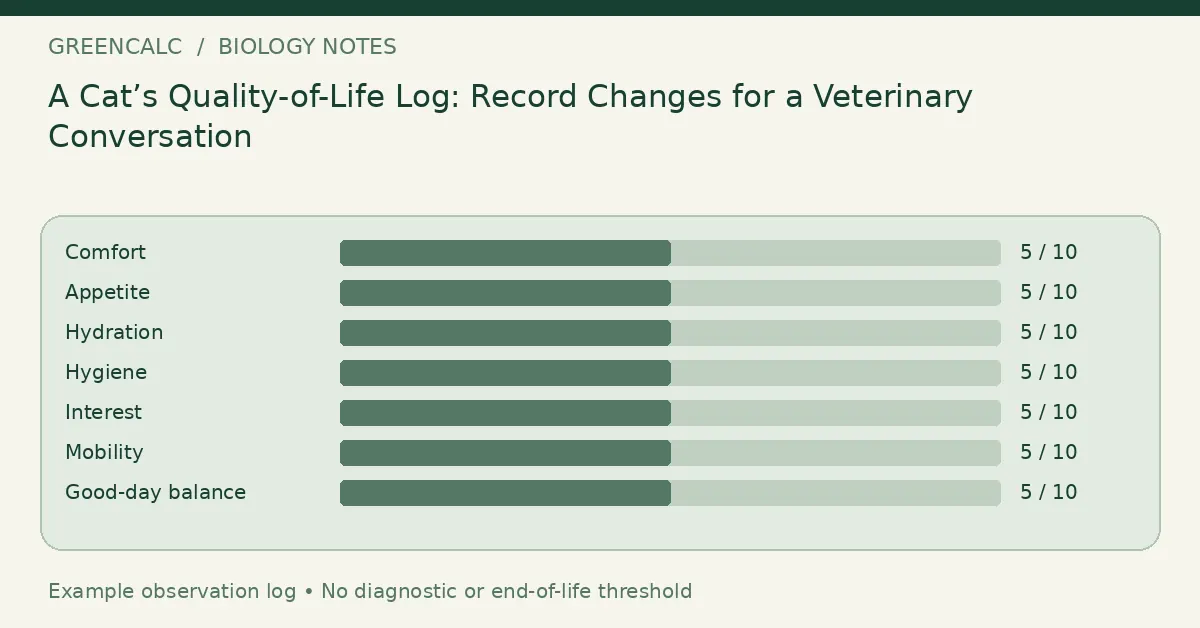
Original instructional diagram for A Cat’s Quality-of-Life Log: Record Changes for a Veterinary Conversation. Values, when shown, are illustrative; clinical images do not recommend a dose.
Observe the cat’s own pattern
Changes in interest, grooming or mobility may be easier to recognize against a consistent personal record. A number assigned on one day should not erase the caregiver’s description of what changed. Keep the individual domain notes alongside the total.
Use Cat Quality of Life Calculator to work through these inputs while keeping the displayed assumptions in view.
Do not turn the score into a diagnosis
The checklist cannot identify pain or disease, prescribe a response or decide end-of-life care. Its purpose is to organize observations for a veterinary conversation. Low or worsening domains deserve discussion even if other domains keep the total high.
This question belongs to the Cat calculators group within Biology calculators.
Read the calculation on its stated basis
Add seven entered observation scores from 0 to 10. Record the total and lowest domain; no clinical threshold is assigned.
An original observation checklist, not a validated diagnostic scale or a euthanasia decision rule.
Retain the input definitions and units with the result. A later comparison should use the same basis; a change in method is a new scenario, not simply a more precise version of the old number.
Keep related questions separate
Cat Age Calculator addresses a related part of the measurement or interpretation task. Check its own method before carrying a value from one tool to the other.
For a related perspective, read Cat Age in Human Years and Feline Life Stages.
For tools in other subjects, return to GreenCalc. Keep the calculator result with its assumptions rather than using a link or a matching unit as evidence that two models are interchangeable.
By GreenCalc · Updated 2026-11-05