
Basal Area from a Plot: Sum Cross-Sections Before Expanding to a Hectare; illustrative quantitative diagram
Define the quantity before calculating
Basal area describes trunk cross-section, not canopy area or the land covered by trees. Square the radius in meters for each recorded diameter, sum those areas, then apply the plot expansion factor. A square-meter total without its plot basis cannot describe a stand per hectare.
Use Basal Area Calculator with the units and the basis stated on its form. Check what each input represents before carrying the output into another record.
Read the model explicitly
Individual basal area m² = π × (diameter cm / 200)². Sum tree areas; plot-scaled m²/ha = sum × 10,000 / plot m².
The Trees & Forestry Calculators group sits within Biology calculators. Keep a measured observation distinguishable from a hypothetical input when moving between its tools.
A worked unit check
| Input as labeled on the tool | Illustrative value |
|---|---|
| Recorded trunk diameters (cm), separated by commas | 20,30,40 |
| Represented plot area (m²) | 1000 |
| Output from the illustrative inputs | Value | Unit |
|---|---|---|
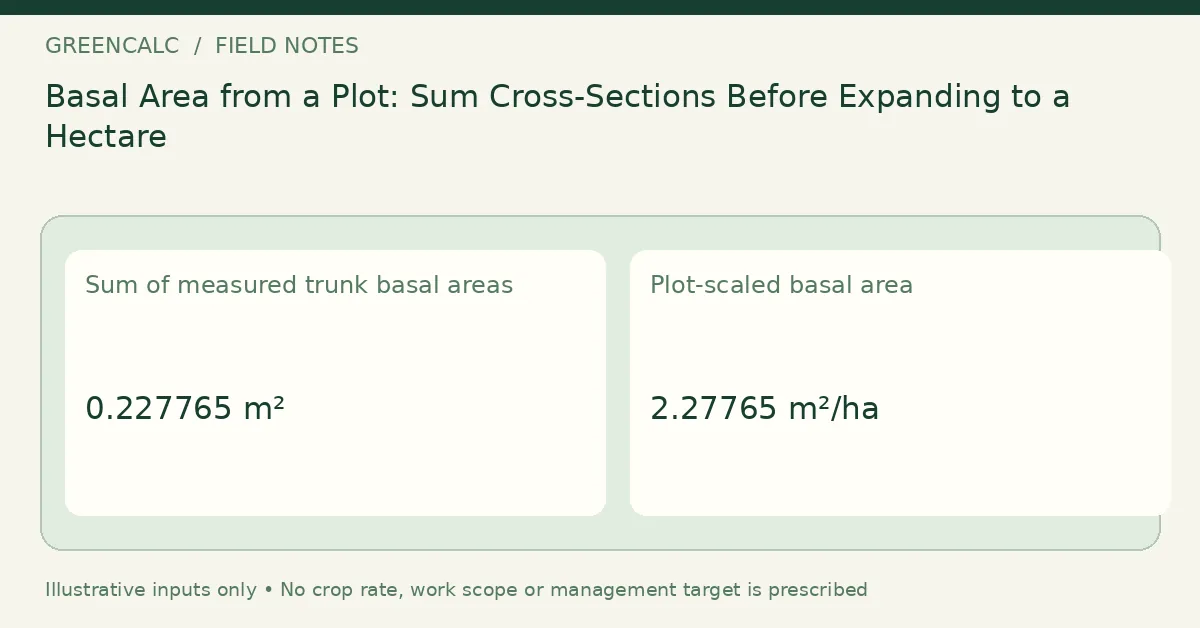
| Sum of measured trunk basal areas | 0.227765 | m² |
| Plot-scaled basal area | 2.27765 | m²/ha |
Record the original input and its unit with this result. Recalculate when the measurement basis changes; changing a unit label after calculation does not convert the quantity. More decimal places do not remove sampling or measurement uncertainty.
A related quantity
Tree Diameter Calculator addresses a related part of the task. Check its own input definition before carrying a number across.
Continue with DBH Records: Consistent Height and Stem Rules Matter in Stand Comparisons for the other part of this measurement question.
Return to GreenCalc for other subjects. Keep raw observations, chosen assumptions and calculated quantities identifiable so a later revision does not overwrite the basis of the original record.
By GreenCalc · Updated 2026-11-06