
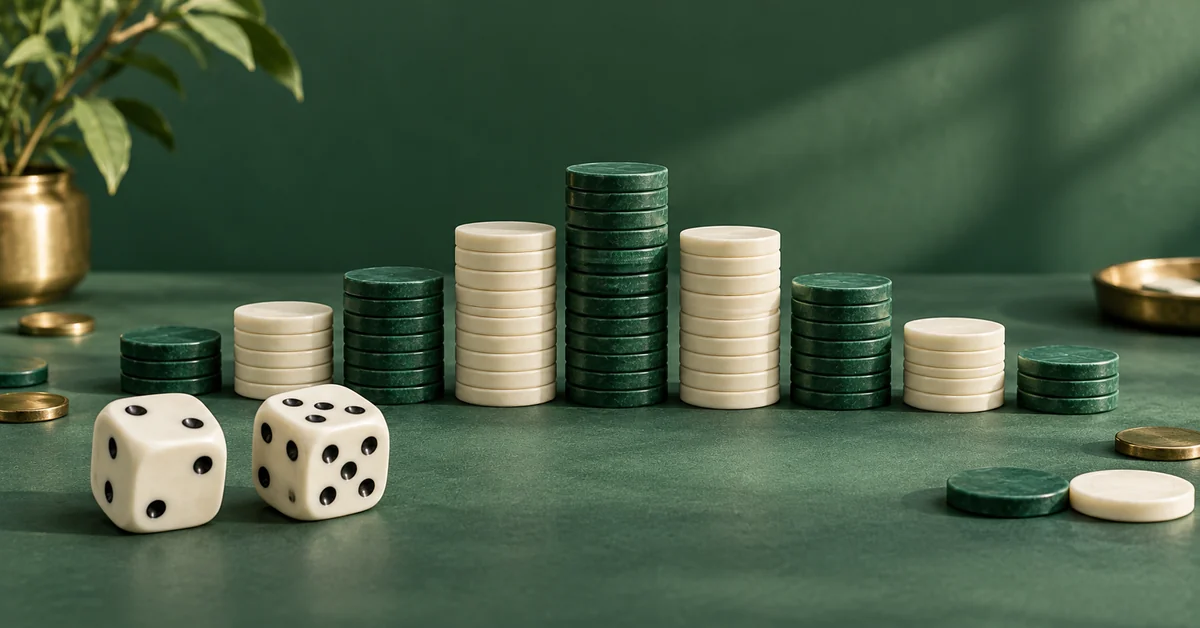
Two generic dice beside several uneven stacks of counting chips. Original AI-generated artwork produced for GreenCalc; not a measured diagram or empirical data display.
Uniform faces do not make uniform sums
Two independent fair six-sided dice have 36 equally likely ordered face pairs. Their possible sums run from 2 through 12, but those eleven sums are not equally likely. Only (1,1) produces 2, while six ordered pairs produce 7. The probability of 7 is 6/36 = 1/6, not 1/11.
Count ordered pairs even when the dice look identical
Label the dice first and second. A first die showing 2 and second showing 5 is a different elementary outcome from first showing 5 and second showing 2. Both contribute to sum 7. The labels are a counting device; no special marking on a physical die is required. The equally likely sample space is the 36 ordered pairs, not the list of distinct totals.
| Sum | Number of pairs |
|---|---|
| 2 or 12 | 1 each |
| 3 or 11 | 2 each |
| 4 or 10 | 3 each |
| 5 or 9 | 4 each |
| 6 or 8 | 5 each |
| 7 | 6 |
Build a larger sum distribution by convolution
For additional independent dice, combine the current sum probabilities with each possible next face. This repeated convolution is the method used by the Dice Probability Calculator. It then selects one total or sums a tail according to the chosen event. For two d6, “at least 7” includes 21 of the 36 ordered pairs, giving 58.3333%.
Keep game rules explicit
The calculator assumes ordinary identical dice numbered 1 through s, without rerolls, keeping only the highest die or exploding outcomes. Those rules change the distribution. Use the Dice Average Calculator for the mean and variance, and read the selected-face complement guide when the question asks about a face appearing rather than a sum.
Check the model behind your result
Use the Dice Probability Calculator for the supported calculation and review its stated assumptions before interpreting the output. Find related tools in the Statistics category, or browse the GreenCalc homepage for other calculation topics.
By GreenCalc Editorial Team · Updated 2026-10-26