
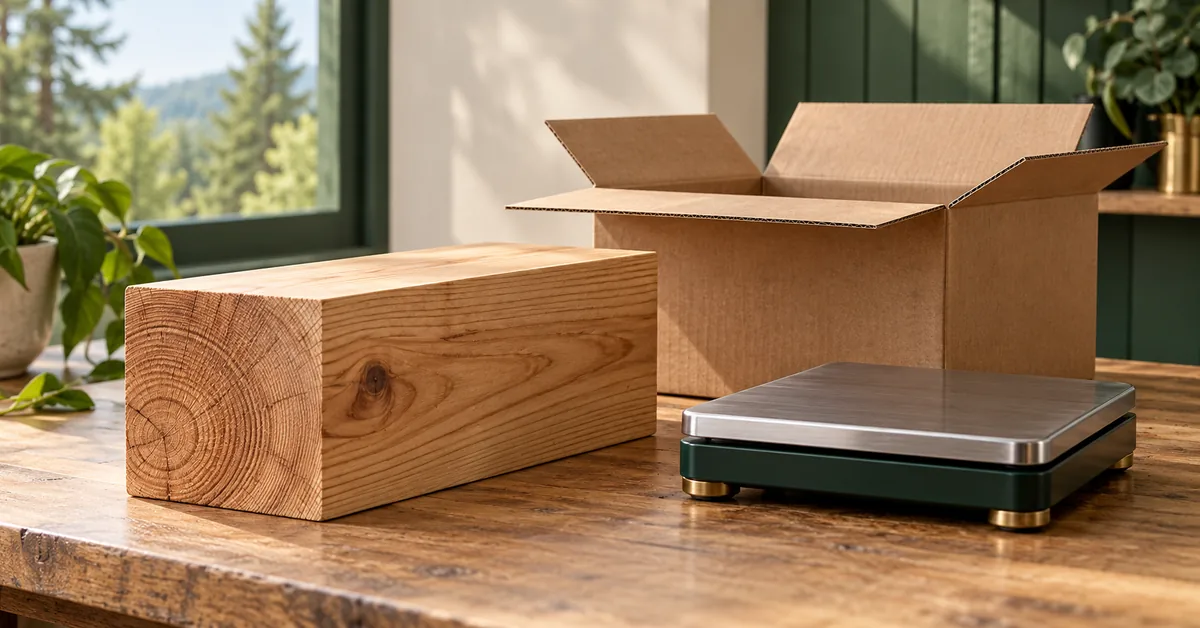
Solid rectangular timber block beside an empty carton and a shipping scale. Original AI-generated artwork produced for GreenCalc; the scene is not a measured construction drawing.
The same outside box dimensions can describe a heavy solid block, a light hollow shell or a package billed using a carrier's dimensional-weight rule. Decide which question you need to answer before multiplying dimensions. An outer envelope is not automatically a volume of solid material.
For a solid block, use the full material volume
For a uniform solid, material volume is length × width × height. A block 40 cm by 30 cm by 25 cm occupies 0.03 m³. If its assumed material density is 700 kg/m³, its mass is 21 kg. The density is an example assumption; it is not a universal value for timber, packaging or any other material.
Use the solid option in the Size to Weight Calculator only when the full entered volume represents the material being modelled. A sealed carton containing mostly air clearly does not meet that assumption.
For an ideal closed shell, subtract the internal cavity
A simplified closed rectangular shell with uniform wall thickness t has material volume LWH − (L−2t)(W−2t)(H−2t). This represents all six walls, with one outside length, width and height and a uniform thickness. Two wall thicknesses must be smaller than every outside dimension.
For the same 40 × 30 × 25 cm outside dimensions and a 0.5 cm wall, the cavity is 39 × 29 × 24 cm = 27,144 cm³. Subtracting that from the 30,000 cm³ envelope leaves 2,856 cm³, or 0.002856 m³ of material. At the hypothetical 700 kg/m³ density, the shell mass is 1.9992 kg.
| Model | Volume used | Example mass at 700 kg/m³ |
|---|---|---|
| Solid block | 0.030000 m³ | 21.0000 kg |
| Ideal closed shell | 0.002856 m³ | 1.9992 kg |
An actual carton may need a measured tare mass
The closed-shell formula does not model an open box, overlapping flaps, corrugated layers, joins or variable wall thickness. Treating corrugated board as a uniform solid slab can be especially misleading because its internal structure includes air. A manufacturer's stated packaging mass or a scale measurement can be more relevant than an idealised shell estimate.
For an actual shipment, separate the empty container, contents and packing materials. If the empty package weighs 0.8 kg, the contents 5 kg and the packing 0.2 kg, the combined actual mass is 6 kg. Do not also add a calculated shell mass if the 0.8 kg tare measurement already includes that shell.
Carrier dimensional weight is a pricing quantity
Carriers may compare a dimensional-weight calculation with actual shipment weight when determining charges. The dimensions, rounding rules, divisor and service conditions must come from the applicable carrier and service. A divisor found in one example is not automatically valid for another service, country or date.
A dimensional weight is therefore not a material-density measurement. The calculator in this article estimates physical material mass or recovers density; it does not quote a carrier's billable weight. Use the carrier's current instructions for that separate task and retain its specified units and rounding sequence.
Choose the input model with a short worksheet
- Is the object a solid, an ideal closed shell, an open container or an assembled package?
- Does the entered density match the material volume, including or excluding voids as appropriate?
- Are contents and fittings already included in the measured mass?
- Do you need physical mass, a delivery payload check or a shipping price?
- What assumptions should remain attached to the result?
The density-selection guide addresses the material-property question in more detail. Keeping geometry, density and carrier pricing on separate worksheet lines prevents a plausible number from being used for the wrong purpose.
Use the Construction calculator collection to follow the measurement workflow, or visit the GreenCalc home page for the complete tool directory.
By GreenCalc Editorial Team · Updated 2026-10-22
Frequently asked questions
What does the hollow-shell formula represent?
A closed rectangular shell with six walls of equal thickness and a cavity reduced by two wall thicknesses along each dimension.
Can an actual package mass be calculated from outer carton size alone?
No. You need an appropriate material model or measured tare mass, contents and packing information; carrier pricing is separate.