
Original instructional diagram for Rat Cage Volume: Why a Capacity Number Can Hide Important Housing Limits. Values, when shown, are illustrative; clinical images do not recommend a dose.
Geometric volume is only a dimension check
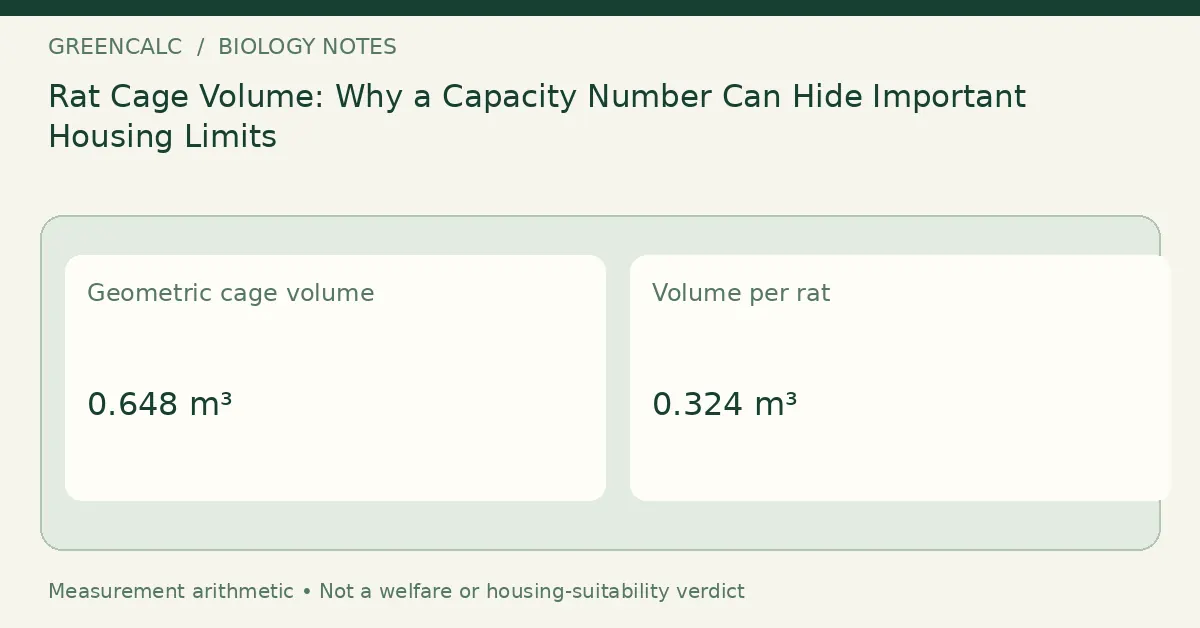
Multiplying internal length, width and height gives a geometric volume, not a welfare assessment or a safe capacity. Dividing by the animal count simply describes volume per animal. It does not prove that another rat can be housed adequately.
Use Rat Cage Calculator to work through these inputs while keeping the displayed assumptions in view.
Check the actual usable design
Usable floor space, climbing routes, ventilation, bar spacing and fall hazards are not represented by one volume number. Social and enrichment needs require separate consideration. Sample dimensions in a calculator are not a recommendation or a universal housing minimum.
This question belongs to the Other animals calculators group within Biology calculators.
Read the calculation on its stated basis
Geometric volume in m³ = internal length × width × height in cm ÷ 1,000,000. Divide by entered rat count for volume per rat.
Dimensions are sample inputs, not a universal welfare minimum. No acceptable animal count is recommended.
Retain the input definitions and units with the result. A later comparison should use the same basis; a change in method is a new scenario, not simply a more precise version of the old number.
Keep related questions separate
Rabbit Cage Size Calculator addresses a related part of the measurement or interpretation task. Check its own method before carrying a value from one tool to the other.
For a related perspective, read Rabbit Housing: Floor Area Alone Cannot Establish Suitability.
For tools in other subjects, return to GreenCalc. Keep the calculator result with its assumptions rather than using a link or a matching unit as evidence that two models are interchangeable.
By GreenCalc · Updated 2026-11-05