
Raised-Bed Top-Ups: Subtract Existing Fill Before Ordering More Material; illustrative quantitative diagram
Define the quantity before calculating
A top-up is the difference between target and existing fill, not the full empty-bed volume. Use the same internal dimensions and depth reference for both measurements. Irregular surfaces may need several observations rather than one convenient depth.
Use Raised Bed Soil Calculator with the units and the basis stated on its form. Check what each input represents before carrying the output into another record.
Read the model explicitly
Additional fill m³ = length m × width m × (target − existing depth) cm / 100 × bed count.
The Gardening and crops calculators group sits within Biology calculators. Keep a measured observation distinguishable from a hypothetical input when moving between its tools.
A worked unit check
| Input as labeled on the tool | Illustrative value |
|---|---|
| Usable internal bed length (m) | 2 |
| Usable internal bed width (m) | 1 |
| Target fill depth (cm) | 30 |
| Existing fill depth on same basis (cm) | 10 |
| Number of matching beds | 2 |
| Output from the illustrative inputs | Value | Unit |
|---|---|---|
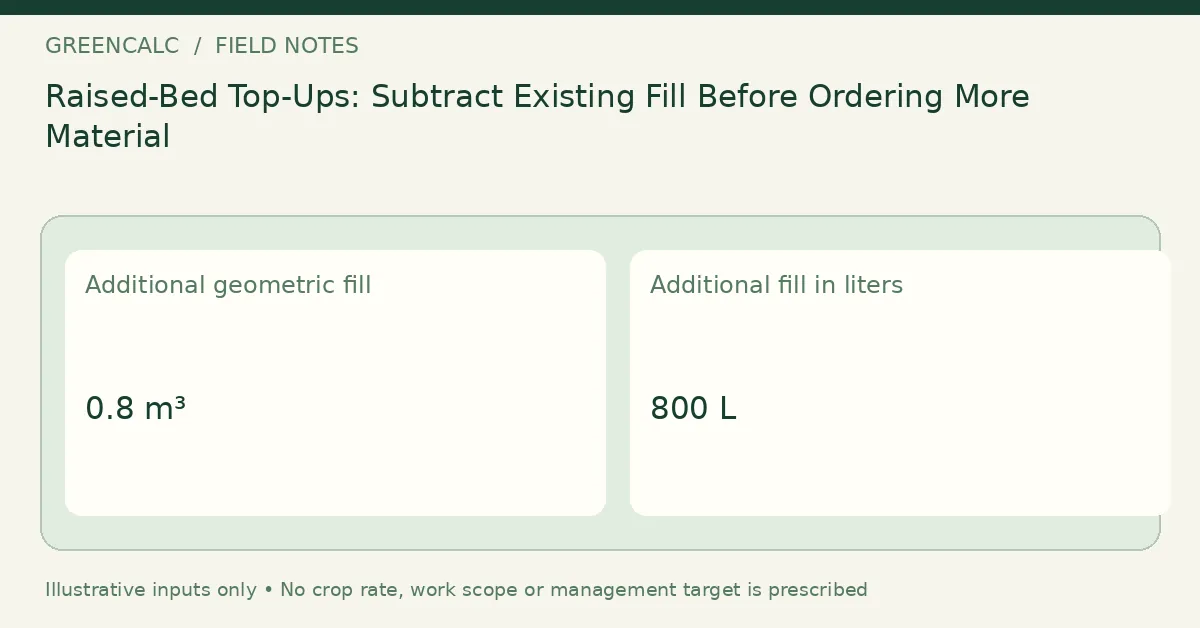
| Additional geometric fill | 0.8 | m³ |
| Additional fill in liters | 800 | L |
Record the original input and its unit with this result. Recalculate when the measurement basis changes; changing a unit label after calculation does not convert the quantity. More decimal places do not remove sampling or measurement uncertainty.
A related quantity
Soil Calculator addresses a related part of the task. Check its own input definition before carrying a number across.
Continue with Depth Records in Raised Beds: Keep Settlement and Layering Explicit for the other part of this measurement question.
Return to GreenCalc for other subjects. Keep raw observations, chosen assumptions and calculated quantities identifiable so a later revision does not overwrite the basis of the original record.
By GreenCalc · Updated 2026-11-06