
Original instructional diagram for A Punnett Square Gives Per-Offspring Probabilities, Not a Family Guarantee. Values, when shown, are illustrative; clinical images do not recommend a dose.
Read one outcome at a time
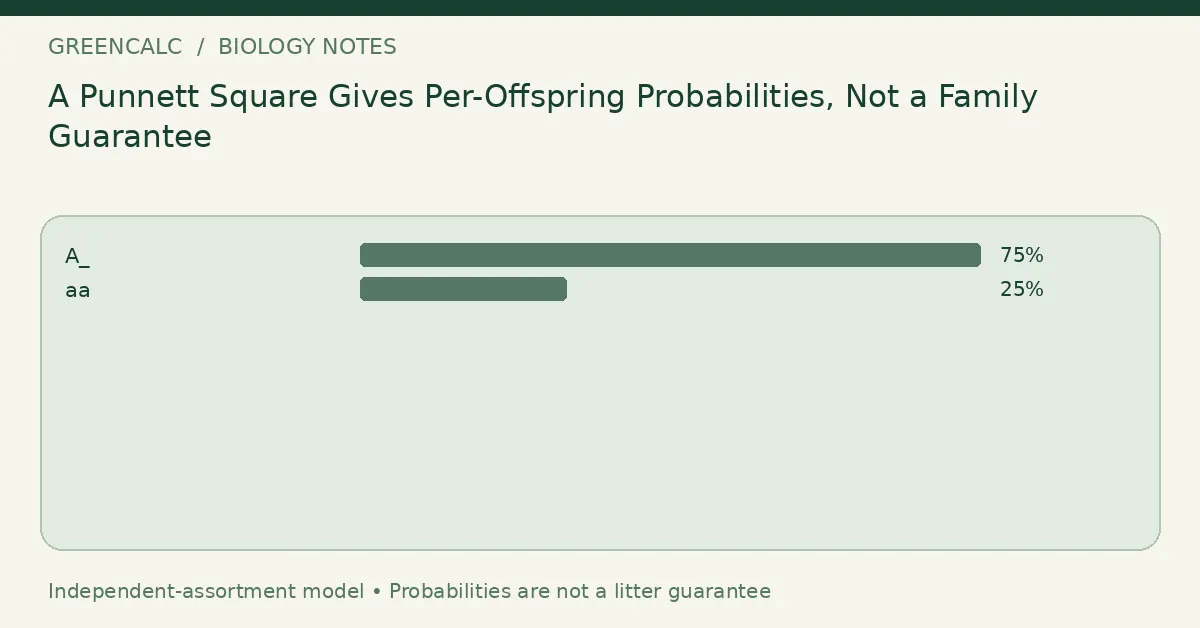
A twenty-five-percent probability for a genotype describes each offspring under the model. It does not promise one such offspring in every set of four. Small families can differ considerably from the expected proportion without changing the arithmetic.
Use Punnett Square Calculator to work through these inputs while keeping the displayed assumptions in view.
Keep the trait assumptions visible
The simple phenotype summary assumes complete dominance at the entered locus. Incomplete dominance, penetrance, sex linkage and viability effects require different models. Entered allele symbols do not supply those biological assumptions automatically.
This question belongs to the Genetics calculators group within Biology calculators.
Read the calculation on its stated basis
Enumerate each parent’s gametes, combine alleles at each locus, then count genotype and complete-dominance phenotype probabilities.
Assumes independent assortment and complete dominance. Does not model linkage, penetrance, viability effects or an individual clinical genetic risk.
A model is useful only within its assumptions. The result describes the input population or cross; it does not supply missing biological information or replace an appropriate genetic assessment.
Keep related questions separate
Dihybrid Cross Calculator - Punnett Square addresses a related part of the measurement or interpretation task. Check its own method before carrying a value from one tool to the other.
For a related perspective, read The 9:3:3:1 Ratio Depends on Independent Assortment.
For tools in other subjects, return to GreenCalc. Keep the calculator result with its assumptions rather than using a link or a matching unit as evidence that two models are interchangeable.
By GreenCalc · Updated 2026-11-05