
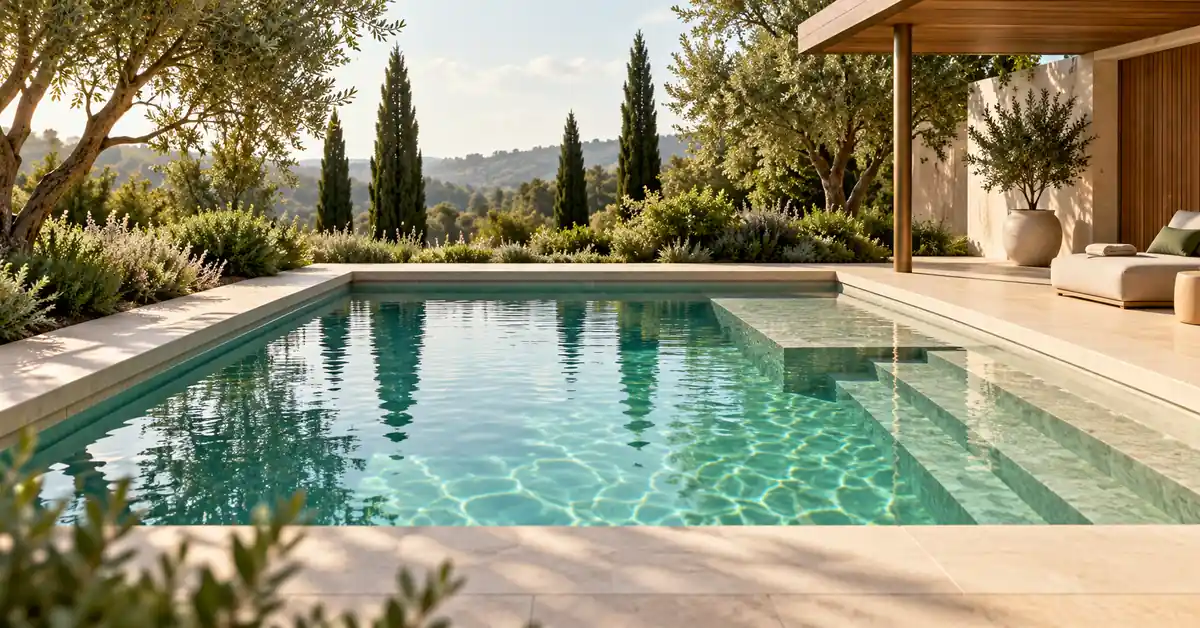
Rectangular swimming pool with a visible waterline and shallow steps. Original AI-generated artwork produced for GreenCalc; the scene is not a measured construction drawing.
A known liquid volume and water depth determine the equivalent constant base area: convert the volume to cubic feet and divide by depth in feet. That area is useful for checking a rectangular tank or pool estimate. It does not uniquely determine a footprint's length and width, and it can mislead when the shape changes with depth.
Recover the base area from a known volume
Choose the reverse mode in the Gallons per Square Foot Calculator. For 1,000 US gallons at a uniform depth of 3 feet, the liquid occupies 1,000 × 231 ÷ 1,728 = 133.680556 cubic feet. Dividing by 3 gives 44.560185 square feet.
Many rectangular footprints have that same area. An 8-foot-long tank would need an equivalent width of approximately 5.570023 feet at that depth. A 10-foot-long tank would need approximately 4.456019 feet. The volume calculation supplies a product of dimensions, not a complete design.
Measure the water, not the outside shell
Use the internal wetted length and width and the actual water depth. Outside dimensions include the walls. Measuring to the rim includes freeboard that may never contain water. A nominal tank size may also include unusable space or volume below a normal outlet.
For a constant rectangular footprint, a small change in water level is straightforward. A 20-foot by 10-foot base has 200 square feet of area. A one-inch level change represents 200 × 48/77 = 124.675325 US gallons. That is the difference between two water levels, not the entire container capacity.
Average end depths only when the geometry supports it
If a rectangular footprint has a bottom that slopes linearly from 3 feet of water depth to 5 feet over the whole length, the average depth is 4 feet. For a 20-foot by 10-foot footprint, this gives 800 cubic feet, or about 5,984.42 US gallons.
The same shortcut does not describe an arbitrary floor with shelves, abrupt steps or varying widths. Divide that shape into sections with suitable areas and depths. A shallow shelf occupying a large area should not receive the same weight as a small deep pocket merely because each was represented by one depth reading.
| Geometry | Suitable approach |
|---|---|
| Vertical walls, flat bottom | Internal footprint × water depth |
| Constant-width footprint, linear bottom slope | Footprint × mean of the end depths |
| Separate shallow and deep zones | Sum each zone's area × depth |
| Curved or tapered walls | Use a geometry-specific volume model or measured calibration |
Account for objects and steps deliberately
A step, built-in seat or immersed object displaces water only over the portion actually submerged. Estimate that occupied volume using its appropriate geometry, then deduct it from the water space. A visible feature above the waterline is not a submerged-volume deduction.
The Cubic Yard Calculator can calculate a rectangular or round displacement volume in cubic feet as well as cubic yards. Keep the deduction in a common volume unit before converting the remaining water volume to gallons.
Label the result for its intended use
Write the waterline, measurement method, gallon system and any deductions with the result. If the volume will feed equipment selection or product instructions, check the relevant manufacturer's requirements and the quality of the volume estimate rather than assuming the last displayed digit is physically measured.
For roof runoff, rainfall depth and collection efficiency answer a different question; use the roof-catchment guide. Neither workflow converts liquid depth into a structural loading approval or a water-treatment instruction.
Use the Construction calculator collection to follow the measurement workflow, or visit the GreenCalc home page for the complete tool directory.
By GreenCalc Editorial Team · Updated 2026-10-22
Frequently asked questions
Do known gallons and depth determine a unique length and width?
No. They determine an equivalent area under the stated geometry; many length-width pairs can have that area.
When is the mean of shallow and deep end depths suitable?
For a constant-width rectangular footprint with a genuinely linear bottom slope. Steps or varying widths need a more detailed model.