
Rounding Bale Orders: A Whole-Unit Count Does Not Standardize Every Bale; illustrative quantitative diagram
Make a controlled comparison
Dividing the adjusted area by coverage gives a fractional planning quantity. Rounding upward selects whole purchase units, but it does not remove uncertainty in the coverage basis. Keep the product, intended depth and allowance together when revising an order.
Pine Straw Calculator makes the stated relationship reproducible. It cannot supply missing product information, identify a representative sample or establish a suitable site-specific management decision.
Change one input at a time
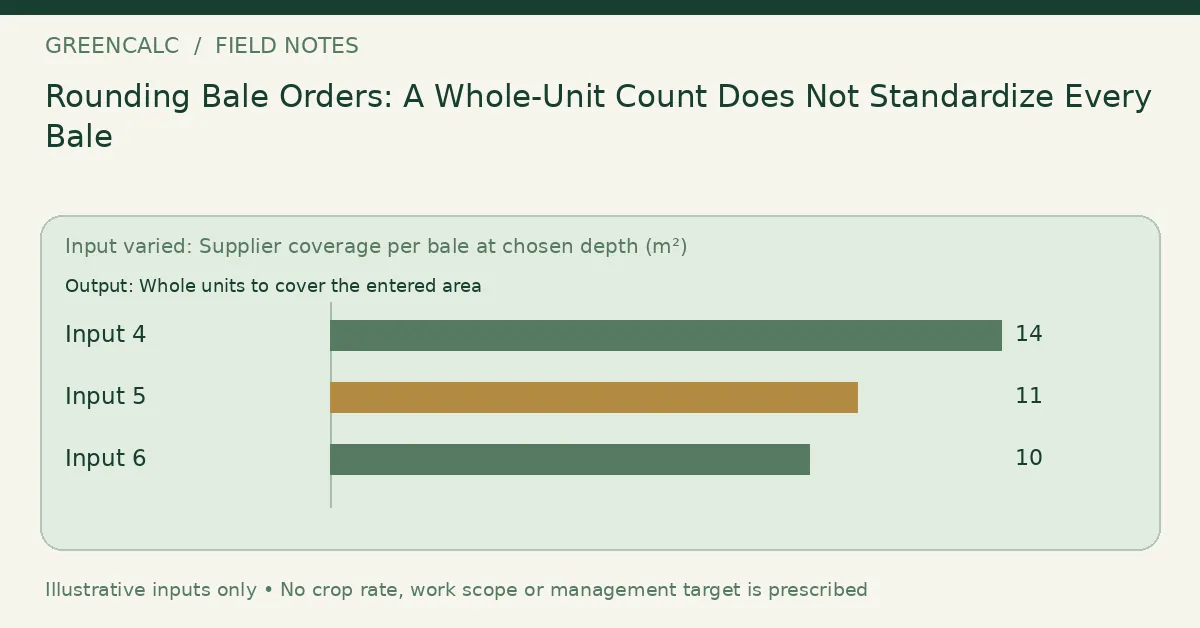
The table varies Supplier coverage per bale at chosen depth (m²) around the illustrative starting value while retaining the other assumptions. These are sensitivity scenarios, not a measured range or recommended settings.
| Supplier coverage per bale at chosen depth (m²) | Selected calculated output | Unit |
|---|---|---|
| 4 | 14 | |
| 5 | 11 | |
| 6 | 10 |
Browse Biology calculators and its Gardening and crops calculators section when another measurement is needed. A related tool may use a different denominator or physical basis.
Keep the interpretation within scope
Keep Supplier coverage per bale at chosen depth (m²) with the selected output in the comparison record. The three alternatives do not identify which input applies to a particular site or product. A justified new observation should be recorded as new evidence, rather than choosing an input merely because its result looks convenient.
A related quantity
Mulch Calculator addresses a related part of the task. Check its own input definition before carrying a number across.
Continue with Pine Straw Bales: Supplier Coverage Needs a Stated Application Depth for the other part of this measurement question.
Return to GreenCalc for other subjects. Keep raw observations, chosen assumptions and calculated quantities identifiable so a later revision does not overwrite the basis of the original record.
By GreenCalc · Updated 2026-11-06