
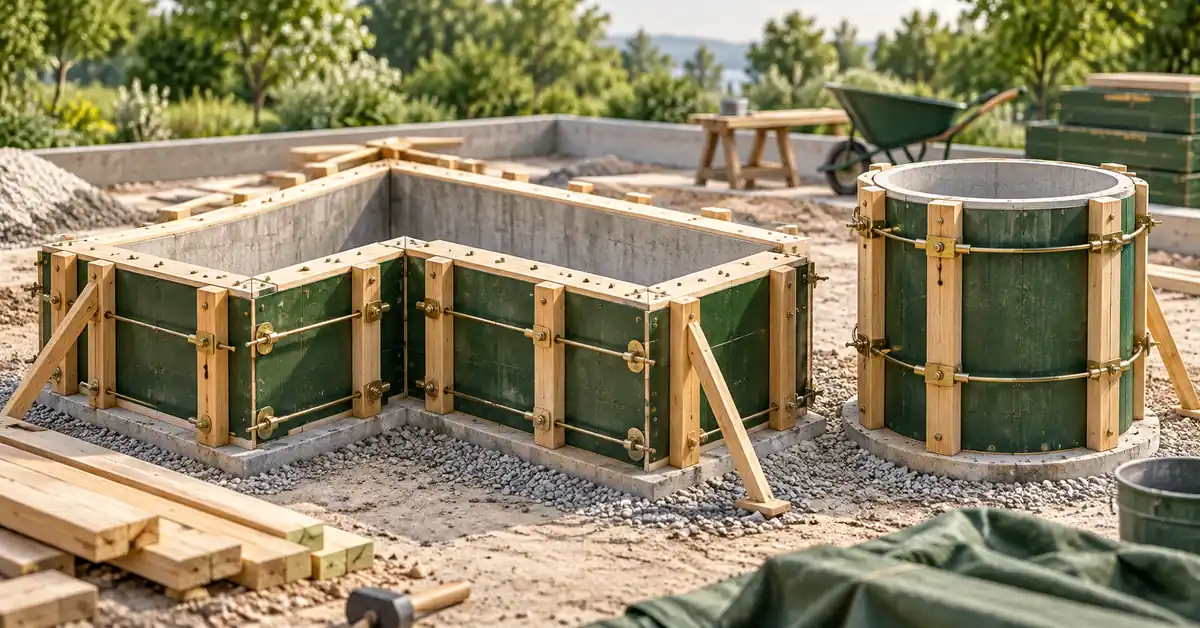
Conceptual L-shaped formwork and a separate round form at a miniature construction site. Original AI-generated artwork produced for GreenCalc; the scene is not a measured construction drawing.
Estimate a mixed-shape pour by dividing it into non-overlapping solids, calculating each net volume, and adding the results before applying one order allowance. The important step is the drawing: a correct formula still overstates the pour if the same corner is counted twice.
Assign a shape and depth to every section
Mark rectangles, circular sections and triangular prisms on a plan. Use the actual internal form dimensions for a contained pour. Where thickness changes, create a separate section rather than applying one thickness to the entire footprint. This quantity calculation does not establish the structural thickness or reinforcement required for the project.
The Cubic Yard Calculator supports rectangular prisms, cylinders, triangular prisms and circular rings. Calculate different sections separately. Its quantity field repeats an identical shape; it does not interpret the geometry of different sections for you.
Build an L-shape with two rectangles
Take a main section 12 feet by 10 feet and a separate 6-foot by 4-foot wing, both 4 inches thick. Assume these footprints touch but do not overlap. Convert the thickness to feet: 4 ÷ 12 = 1/3 foot.
| Section | Footprint | Net volume |
|---|---|---|
| Main section | 12 × 10 = 120 ft² | 120 × 1/3 = 40 ft³ |
| Wing | 6 × 4 = 24 ft² | 24 × 1/3 = 8 ft³ |
| Total | 144 ft² | 48 ft³ = 1.777778 yd³ |
If your first rectangle already includes the wing's overlap, subtract the duplicated footprint once. An alternative is to draw one bounding rectangle and deduct a missing corner. Both methods should give the same area when the sketch and measurements describe the same shape.
Add a round section without substituting a square
A separate circular section 3 feet in diameter and 2 feet high has volume π × 1.5² × 2 = 14.137167 cubic feet, or approximately 0.523599 cubic yard. The diameter is not the radius: using 3 feet as the radius would multiply the answer by four.
Adding that round section to the L-shaped example gives about 2.301377 cubic yards before any allowance. These dimensions are a geometry example, not a recommendation for a footing or other structural component.
Deduct only real voids
A hollow cylindrical form can be calculated as a ring when the inner and outer diameters and height describe a genuine open volume. The ring volume is π × (outer diameter² − inner diameter²) × height ÷ 4. The inner diameter must be smaller than the outer diameter.
Do not deduct a feature merely because it appears on a drawing: determine whether it actually displaces material throughout the pour depth. Small embedded items, reinforcement and large planned blockouts are different cases. The person specifying the pour should confirm which deductions belong in an order quantity.
Apply the ordering decision once
After summing net sections, a chosen 5% allowance on 2.301377 cubic yards produces approximately 2.416445 cubic yards. If a supplier sells only in specified increments, apply its increment after the allowance. Neither 5% nor a particular increment is universal.
Putting an allowance on every section and then adding another allowance to the sum counts the same contingency twice. Keep the net total on the worksheet even if the supplier's order is rounded upward, so a later change in dimensions can be recalculated cleanly.
Keep the check independent
For uniform-depth sections, verify the footprint using the Square Footage Calculator, then multiply the net area by the thickness. If you already have an approved area figure, the Square Feet to Cubic Yards Calculator avoids rebuilding the footprint from lengths. Use the net-volume and delivery guide for the remaining supplier and rounding questions.
Use the Construction calculator collection to follow the measurement workflow, or visit the GreenCalc home page for the complete tool directory.
By GreenCalc Editorial Team · Updated 2026-10-22
Frequently asked questions
When should an order allowance be applied?
Establish and sum the checked net section volumes first, then apply one chosen allowance to the total.
Can I use the same quantity multiplier for different shapes?
No. The multiplier repeats an identical section; different dimensions or shapes require separate calculations.