
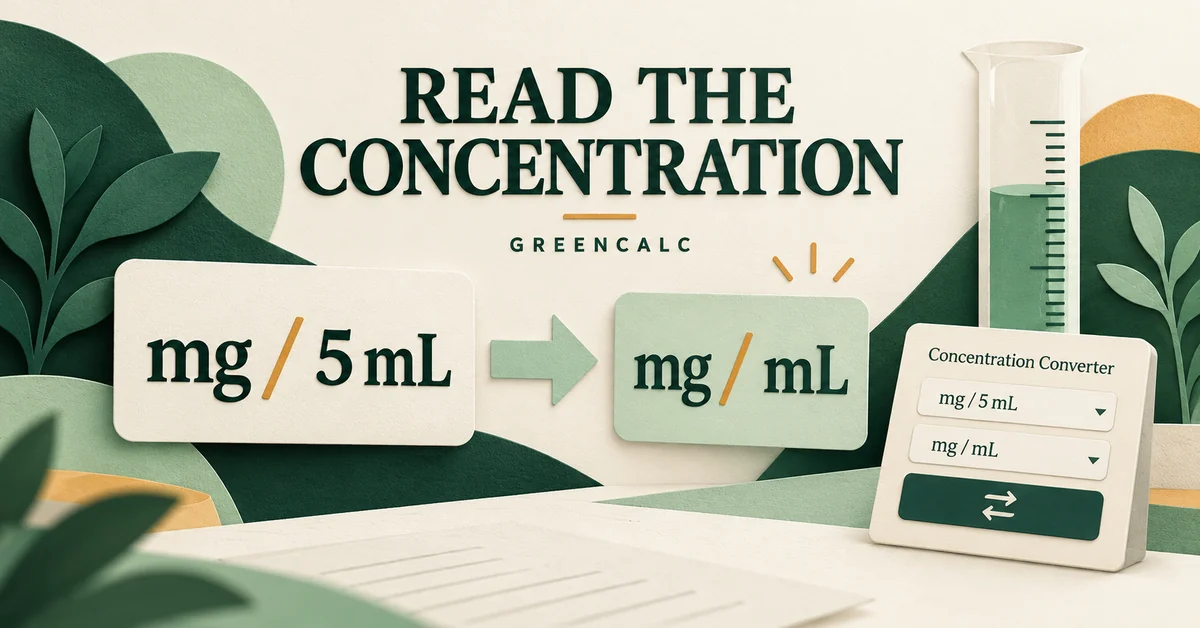
Original GreenCalc editorial illustration for reading concentration labels. The two unit cards introduce normalization before entering a value in the mg to mL Calculator; they are not a medicine label.
A label that says 100 mg per 5 mL does not mean 100 mg per mL. It means that 5 mL of the mixture contains 100 mg of the specified ingredient. Dividing 100 by 5 gives the concentration for one milliliter: 20 mg/mL.
This guide uses fictional solution examples to explain the arithmetic. Once the concentration is in mg/mL, enter it into the mg to mL Calculator using Custom. If you are unsure whether your number is a concentration or a density, read density versus concentration in mg to mL conversions first.
What “mg per 5 mL” means
The word “per” connects an ingredient mass to a stated volume of the mixture. The volume after “per” is part of the concentration. It cannot be dropped.
For a fictional dye solution labeled 100 mg per 5 mL, the equivalent ratios are:
- 100 mg in 5 mL of solution;
- 20 mg in 1 mL of solution;
- 200 mg in 10 mL of solution, assuming the same uniform concentration.
These expressions describe the same strength. They do not prescribe an amount to use. They also do not describe the total mass of the solution: the solvent contributes mass too.
Step 1: convert the label to mg/mL
Use concentration in mg/mL = stated ingredient mass in mg ÷ stated solution volume in mL. Keep both numbers from the same label or specification.
| Illustrative concentration statement | Calculation | Equivalent concentration |
|---|---|---|
| 25 mg per 5 mL | 25 ÷ 5 | 5 mg/mL |
| 100 mg per 5 mL | 100 ÷ 5 | 20 mg/mL |
| 150 mg per 10 mL | 150 ÷ 10 | 15 mg/mL |
| 40 mg per 2 mL | 40 ÷ 2 | 20 mg/mL |
Notice that 100 mg per 5 mL and 40 mg per 2 mL describe the same concentration. Comparing only the milligram numbers would suggest a difference that disappears when the volumes are included.
Step 2: calculate a volume from a known ingredient mass
Suppose an educational problem asks for the solution volume containing 60 mg of dye, and the solution specification is 100 mg per 5 mL. First calculate 100 ÷ 5 = 20 mg/mL. Then calculate 60 ÷ 20 = 3 mL.
You can also keep the original ratio: 60 mg × (5 mL ÷ 100 mg) = 3 mL. The mg units cancel and leave mL. Both methods produce the same result.
Entering 100 into a field labeled mg/mL would give 0.6 mL instead. That result is five times too small because the label’s 5 mL denominator was lost. Normalizing the concentration before using the calculator makes the assumption visible.
Step 3: check with the reverse calculation
Multiply the result by the concentration: 3 mL × 20 mg/mL = 60 mg. For a second check using the original label, 3 mL is three-fifths of 5 mL, so it contains three-fifths of 100 mg. That is also 60 mg.
These checks confirm the relationship between the supplied numbers. They cannot establish that a product is appropriate to use, that a solution is uniform, or that the original specification was copied correctly.
Other concentration units you may encounter
The calculator’s custom field expects mg/mL. Convert other units before entering a number:
| Given unit | Conversion to mg/mL | Example |
|---|---|---|
| mg/L | Divide by 1,000 | 2,000 mg/L = 2 mg/mL |
| g/L | The numerical value stays the same | 2 g/L = 2 mg/mL |
| g per 100 mL | Multiply the number by 10 | 0.5 g per 100 mL = 5 mg/mL |
| micrograms/mL | Divide by 1,000 | 500 micrograms/mL = 0.5 mg/mL |
The g/L relationship follows from converting both sides: 1 g is 1,000 mg and 1 L is 1,000 mL. The two factors cancel. A bare percentage needs more information. Do not assume that a percentage by mass, volume, or mass per volume means the same thing.
Numbers that look like concentrations but are not enough
A bottle marked “100 mL” gives a container volume, not an ingredient concentration. “100 mg” alone gives a mass without telling you what liquid volume contains it. A quantity expressed in activity units is not automatically convertible into milligrams either.
If the required denominator or ingredient identity is missing, do not fill the gap with water’s density. The missing information must come from the actual label, specification or another reliable source for that formulation.
Using the normalized concentration in the calculator
- Open the mg to mL Calculator.
- Select Custom and enter the normalized mg/mL value in Density / Concentration.
- Choose mg for mass and mL for volume.
- Enter the ingredient mass supplied by your problem or specification.
- Read the calculated volume and check it against the original ratio.
For medicine labels, a calculated volume does not determine a suitable dose. Follow the supplied instructions and ask a pharmacist if the strength, measuring device or directions are unclear. FDA advises checking how to use a medicine and obtaining an appropriate measuring tool for liquids.
For the underlying difference between whole-material mass and ingredient mass, return to the density and concentration guide. More tools are listed under Conversion calculators.
By GreenCalc Editorial Team · Updated 2026-10-19
Frequently asked questions
How do I convert 100 mg per 5 mL into mg/mL?
Divide 100 mg by 5 mL to get 20 mg/mL. This is a concentration conversion, not a recommendation for how much to use.
Is 100 mg per 5 mL the same as 100 mg/mL?
No. The first is 20 mg/mL, while the second is 100 mg/mL. The second concentration is five times as large.
Does a bottle volume tell me its concentration?
No. A bottle volume such as 100 mL does not state how much of a specified ingredient is present per unit volume.