
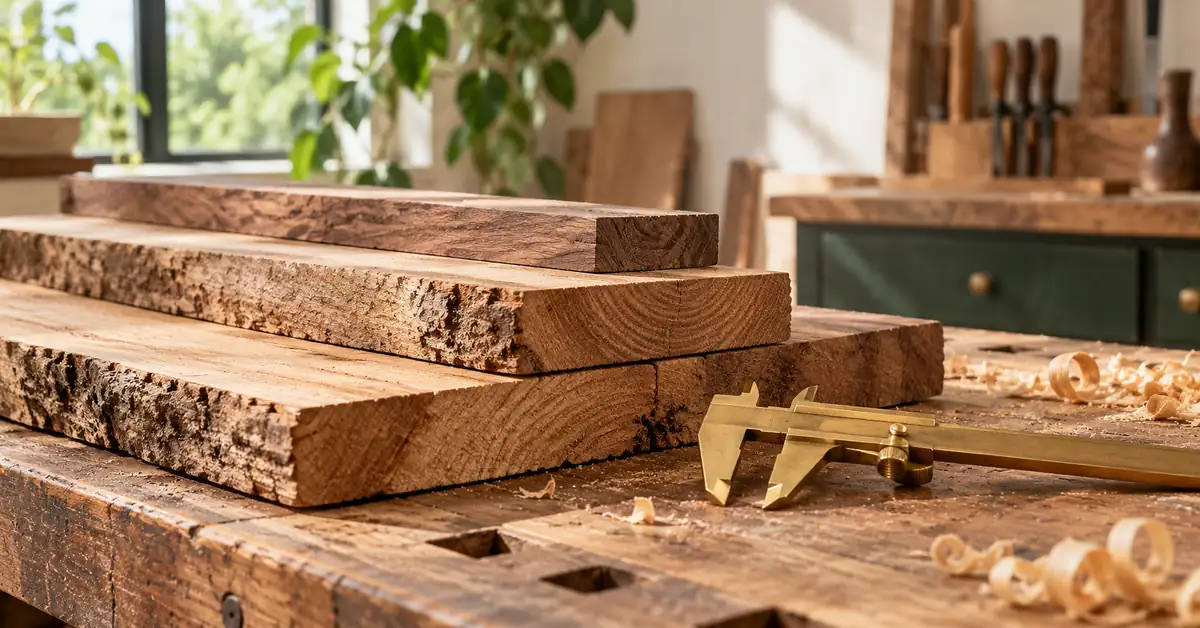
Rough hardwood boards and a caliper on a joiner’s bench. Original AI-generated artwork produced for GreenCalc; the scene is not a measured construction drawing.
A board-foot price is only comparable when the seller's tally and your calculation use the same dimension basis. A surfaced board can contain less physical wood than its rough-stock description suggests, while the invoice still follows an agreed trade measurement. Ask which measurement is being sold before comparing the price.
Write down the quantity the seller will bill
For a geometrical board-foot calculation, one board foot is a volume of 144 cubic inches. Thickness in inches multiplied by width in inches and length in feet, divided by 12, gives board feet per board. Multiply by the board count after calculating the individual quantity.
The Board Foot Calculator lets you identify the entered dimensions as actual measurements or seller-supplied trade dimensions. That label records the basis; it does not invent a billing convention. A retailer may use nominal thickness, minimum billable thickness, width rounding or a particular tally method. Obtain those rules from the quote and enter the corresponding dimensions yourself.
Rough thickness and finished thickness answer different questions
Hardwood descriptions such as 4/4 and 8/4 refer to quarter-inch thickness designations: 4/4 is one inch and 8/4 is two inches before any particular surfacing specification is applied. A designation alone does not guarantee the final thickness after drying, flattening and planing. Bow, cup and the intended finished dimension also affect usable yield.
Suppose a seller quotes a board as 1 inch by 8 inches by 8 feet. On that entered basis, its quantity is 1 × 8 × 8 ÷ 12 = 5.3333 board feet. If you later measure the surfaced board at 0.75 inch by 7.5 inches by 8 feet, its physical volume is 3.75 board feet. These values describe different stages or conventions. They are not evidence that either measurement was calculated incorrectly.
| Record | What it answers | What to confirm |
|---|---|---|
| Rough-stock designation | Which stock was purchased? | Nominal size and tally rules |
| Actual delivered dimensions | How much physical volume is present? | Thickness, width and length at delivery |
| Finished part dimensions | Will the stock make the required component? | Machining allowance and defects |
Check the arithmetic of a quoted bundle
Consider five identical boards with entered dimensions of 1.25 inches thick, 10 inches wide and 8 feet long. Each contains 8.333333… board feet on that basis; the bundle contains 41.666666… board feet. At a hypothetical quote of 4.15 currency units per board foot, the unrounded quantity produces a material cost of 172.916666…, normally displayed as 172.92.
Keep extra digits until the final total. Rounding each board to 8.33 before multiplying introduces a small discrepancy. A commercial tally may legitimately apply a different rounding rule, but that rule should be stated rather than guessed. Delivery, tax, selection fees and surfacing charges belong in separate quote lines.
Compare useful stock as well as the headline price
A lower price per board foot does not necessarily yield cheaper finished parts. Narrow boards, knots, checks or difficult grain placement can reduce usable pieces. Compare the grade, moisture condition, available widths and required lengths alongside the price. Your cut list should identify the pieces that cannot be joined or shortened without changing the design.
An optional allowance in the calculator increases the entered quantity and estimated cost by your chosen percentage. It is a purchasing scenario, not an assurance of yield. For the actual cutting workflow, use the separate guide to turning a furniture cut list into a lumber order.
Questions to put on the order sheet
- Are thickness and width rough, nominal or actual delivered measurements?
- Is stock thinner than one inch tallied using a minimum billable thickness?
- Are lengths and widths rounded, and at what stage?
- Does the price include surfacing, straight-line ripping or delivery?
- What final thickness and moisture condition are being supplied?
Once these answers are written down, repeat the calculation using the same basis as the quote. Keep the original measurements with the result so a later invoice can be checked without reconstructing the purchase from memory.
Use the Construction calculator collection to follow the measurement workflow, or visit the GreenCalc home page for the complete tool directory.
By GreenCalc Editorial Team · Updated 2026-10-22
Frequently asked questions
Why can a surfaced board have fewer physical board feet than the invoice tally?
The invoice may use an agreed rough or trade dimension basis. Compare the stated tally rules with the actual measurements rather than assuming they describe the same stage.
Should every board be rounded before adding the total?
For a geometric check, keep precision until the final total. If a commercial tally rounds differently, record the seller’s stated method.