

Original editorial illustration for From Field Samples to Yield Estimates and Grain Records
Define what the sample represents
A detailed measurement from a selected patch can still be a poor representation of the field. Record locations, represented area, timing and the selection method before expanding a sample. The simple tools below calculate consequences of a sample definition; they do not identify a representative location or supply an uncertainty interval automatically.
Separate counts, mass and saleable quantity
Kernel counts, standing plants, harvested kilograms and a marketable fraction describe different stages. A grain-volume conversion adds another definition: the bushel or weight convention in use. Keep each stage visible instead of turning a single promising observation into an unqualified field-yield or sales statement.
Retain the moisture and observation period
Fresh weight and dry matter are not the same basis, and a short picking period is not a whole season. Likewise, converting grain mass into accounting bushels does not apply a moisture adjustment or grade deduction. The examples are arithmetic scenarios; measured records and the applicable product or trade definitions must supply the inputs.
Start in Biology calculators for the field and measurement tools. This workflow also distinguishes questions handled in Statistics calculators, Food calculators. Follow the quantity and its definition rather than assuming that a shared unit makes different models interchangeable.
Worked case 1: Corn Yield Calculator
The kernel-count scenario combines a sample ear count with average rows and kernels and an externally chosen kernels-per-kilogram basis. Each term has a separate measurement meaning. A generic kernel-mass assumption can dominate the mass estimate even when the count arithmetic is exact.
Calculate this scenario with Corn Yield Calculator using the following stated inputs.
| Input definition | Illustrative value |
|---|---|
| Ears counted in sample | 30 |
| Mean kernel rows per ear | 16 |
| Mean kernels per row | 30 |
| Represented sample area (m²) | 10 |
| Kernels per kg on the chosen moisture basis | 3000 |
| Calculated quantity | Result | Unit |
|---|---|---|
| Estimated sample grain mass | 4.8 | kg |
| Extrapolated grain yield | 4.8 | t/ha |
The field extrapolation inherits both the sample’s representativeness and the kernel-mass basis. It does not apply harvest losses or moisture shrink. Keep the count measurements and the mass assumption separately available when revising the estimate.
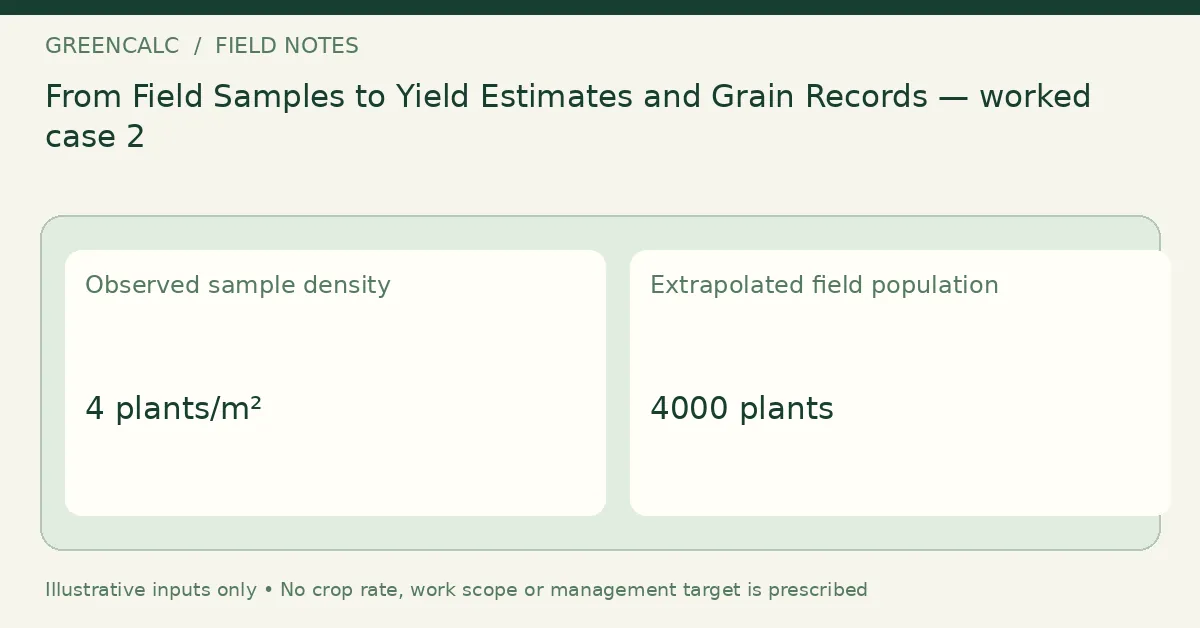
Worked case 2: Plant Population Calculator
A stand count expands established plants rather than grain mass. Comparing this with an intended planting density can be useful, but it does not establish the cause of a difference. The observation date and sample area still belong in the record.
Calculate this scenario with Plant Population Calculator using the following stated inputs.
| Input definition | Illustrative value |
|---|---|
| Established plants counted in sample | 40 |
| Represented sample area (m²) | 10 |
| Field area being extrapolated (m²) | 1000 |
| Calculated quantity | Result | Unit |
|---|---|---|
| Observed sample density | 4 | plants/m² |
| Extrapolated field population | 4000 | plants |
| Equivalent density per hectare | 40000 | plants/ha |
Do not substitute a planned seed count for an observed stand count. Germination, establishment and later losses can separate them. An extrapolated population is not a guarantee that the same density occurs in every part of the field.
Worked case 3: Vegetable Yield Calculator
The vegetable example starts from harvested mass over a stated sample area and period. It then applies a separately entered marketable share. That separation lets the record distinguish changes in crop production from changes in sorting or intended use.
Calculate this scenario with Vegetable Yield Calculator using the following stated inputs.
| Input definition | Illustrative value |
|---|---|
| Represented harvested sample area (m²) | 10 |
| Harvest mass from that sample and stated period (kg) | 30 |
| Crop area extrapolated (m²) | 100 |
| Assumed marketable fraction (%) | 80 |
| Calculated quantity | Result | Unit |
|---|---|---|
| Observed harvest density | 3 | kg/m² |
| Extrapolated total mass | 300 | kg |
| Mass after entered marketable share | 240 | kg |
The marketable result does not certify a grade or predict demand. A larger harvest sample and a different marketable percentage change different assumptions. Preserve both values instead of reporting only a final combined number.
Worked case 4: Grain Conversion Calculator
This conversion uses an explicitly entered pounds-per-bushel basis. It can represent an intended commodity convention, but the calculator does not discover the correct convention from the grain name. The arithmetic must be accompanied by that definition.
Calculate this scenario with Grain Conversion Calculator using the following stated inputs.
| Input definition | Illustrative value |
|---|---|
| Quantity in the selected starting unit | 100 |
| Convert | bu-to-kg |
| Defined commodity or measured weight (lb per US bushel) | 56 |
| Calculated quantity | Result | Unit |
|---|---|---|
| Mass on the entered bushel-weight basis | 2540.12 | kg |
| Metric tonnes | 2.54012 | t |
A mass conversion does not measure the bulk density of the stored load or apply a moisture deduction. If the record is used in a transaction, the applicable measurement and reporting requirements need separate confirmation.
The Grain weight and discount definitions distinguishes grain-weight and accounting definitions. Preserve the basis of a weigh or conversion record before comparing quantities.
Worked case 5: Grain Bin Calculator
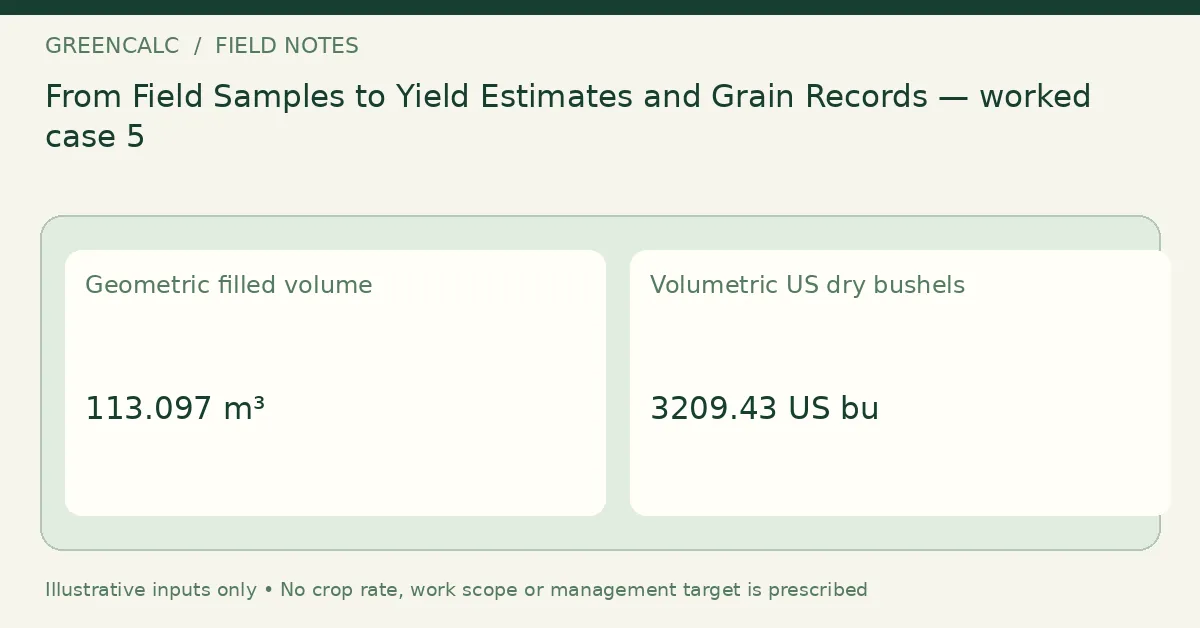
The bin scenario estimates geometric filled capacity from internal dimensions. A volumetric US dry bushel is the output unit, not a measured mass. A level fill and a conical top require different geometric terms.
Calculate this scenario with Grain Bin Calculator using the following stated inputs.
| Input definition | Illustrative value |
|---|---|
| Internal circular diameter (m) | 6 |
| Filled cylindrical depth (m) | 4 |
| Additional filled cone height (m) | 0 |
| Calculated quantity | Result | Unit |
|---|---|---|
| Geometric filled volume | 113.097 | m³ |
| Volumetric US dry bushels | 3209.43 | US bu |
Do not infer a load’s exact weight from this capacity alone. Actual fill shape, obstructions and product density matter. Never enter a grain bin to obtain a missing measurement; the calculator does not provide safe-entry or confined-space procedures.
The Geometric storage-capacity context provides context for geometric storage estimates. It does not make entry into a grain structure safe or certify actual inventory.
Worked case 6: Grain Conversion Calculator
Changing only the entered bushel-weight basis demonstrates why the word bushel needs context. The starting count remains the same while the computed mass changes. That is a change in the selected relationship, not an increase in the amount physically harvested.
Calculate this scenario with Grain Conversion Calculator using the following stated inputs.
| Input definition | Illustrative value |
|---|---|
| Quantity in the selected starting unit | 100 |
| Convert | bu-to-kg |
| Defined commodity or measured weight (lb per US bushel) | 60 |
| Calculated quantity | Result | Unit |
|---|---|---|
| Mass on the entered bushel-weight basis | 2721.55 | kg |
| Metric tonnes | 2.72155 | t |
Keep nominal accounting conventions and measured density records distinct. A revised basis should be documented rather than silently replacing a prior one. The calculator supplies neither grade certification nor a market price for the result.
Use a unit ladder to check the yield expansion
The illustrative corn sample contains an estimated four-point-eight kilograms of grain over ten square meters. That corresponds to zero-point-four-eight kilograms per square meter. Expanding to ten thousand square meters gives four thousand eight hundred kilograms per hectare, or four-point-eight metric tonnes per hectare. Writing this unit ladder makes the hectare and tonne conversions visible instead of burying them in one coefficient.
Now hold the kernel count fixed but change the assumed kernels per kilogram from three thousand to two thousand four hundred. The estimated sample mass becomes six kilograms, and the expanded yield becomes six tonnes per hectare. A twenty-percent reduction in this denominator produces a twenty-five-percent increase in the mass estimate. The relationship is inverse, so equal percentage changes in input and output should not be assumed.
These are sensitivity examples, not evidence that a field’s crop changed. The kernel-mass basis, moisture definition and sample selection would need actual support before the number could represent a harvest estimate. Keep the raw count observations available so another person can reproduce either scenario. A later scale weight or a new moisture measurement is new evidence; it should not be silently relabeled as a correction to a previously measured quantity that was never actually measured.
Check the record before using it elsewhere
Use the following questions to audit this particular workflow. An unanswered question is an input or interpretation issue; it should not be hidden by rounding the output or choosing a result that resembles the expected answer.
- What area and date does the sample represent?
- Were locations selected to support the intended inference?
- Is the observation a count, a volume or a mass?
- What moisture basis accompanies a mass estimate?
- Does marketable fraction describe an assumption or an observed sorting record?
- Which bushel-weight convention is being used?
- Is geometric capacity being confused with actual inventory?
- Which uncertainty requires another measurement rather than more decimal places?
Retain a revisable measurement sheet
Keep the original observations, the date and the input definitions alongside the calculated result. When a plan changes, record the new scenario separately instead of replacing the evidence behind an earlier estimate. A measured change, a revised assumption and a unit conversion are different events in the record.
Use Corn Yield Calculator for the main quantity in this workflow. For other subjects, return to GreenCalc; for a related calculation, begin with its own units, basis and limitations rather than transferring a result by name alone.
By GreenCalc · Updated 2026-11-06