
Original editorial illustration for Fertilizer Labels and Water Volumes: Keep Nutrient Units Consistent
Obtain the target before converting it
A calculator can convert a nutrient target into a product quantity, but it does not establish the target. An appropriate soil or nutrient plan supplies that decision. Keep its nutrient definition, area basis and timing with the record. A product percentage is then an input to a mass calculation, not a recommendation to use that product on every site.
Read the substance represented by the label
Nitrogen mass, an oxide-label convention and total fertilizer-product mass are different quantities. A number expressed as elemental phosphorus should not be divided by an oxide percentage without a suitable basis conversion. State exactly what is being matched before comparing labels or assuming that the same numerical percentage describes interchangeable nutrients.
Keep field amounts and solution concentrations separate
A mass per hectare refers to an area. Milligrams per liter refer to a solution volume. Both can be calculated from a product percentage, but neither supplies the missing area, volume or application context of the other. Stock solutions, injectors, solubility and compatibility involve additional information beyond the final-solution arithmetic used here.
Start in Biology calculators for the field and measurement tools. This workflow also distinguishes questions handled in Conversion calculators, Chemistry calculators. Follow the quantity and its definition rather than assuming that a shared unit makes different models interchangeable.
Worked case 1: Fertilizer Calculator
This example begins with an externally supplied nitrogen target and a product whose nitrogen fraction is stated on a matching basis. Multiplying the area by the target gives nutrient mass; dividing by the product fraction gives product mass. The chosen rate is illustrative, not an agronomic recommendation.
Calculate this scenario with Fertilizer Calculator using the following stated inputs.
| Input definition | Illustrative value |
|---|---|
| Application area (ha) | 2 |
| Nutrient target from the site plan (kg/ha) | 50 |
| Product percentage for that same nutrient (%) | 20 |
| Target and label nutrient basis | N |
| Calculated quantity | Result | Unit |
|---|---|---|
| Total nutrient target | 100 | kg of N |
| Fertilizer product corresponding to target | 500 | kg product |
The number of kilograms of product is larger than the nutrient mass because the product is not pure nitrogen. A percentage entered as twenty rather than its decimal fraction must be handled by the stated formula. Keep other nutrients and the actual product analysis in view separately.
The Nutrient-label conventions explains why the nutrient convention on a label matters. Preserve that convention when matching a target to a product fraction.
Worked case 2: Fertilizer Calculator
Changing the grade while holding area and nutrient target constant isolates the effect of concentration in the product. The result can support a quantity comparison, but the two products are not thereby shown to have the same agronomic suitability or complete nutrient analysis.
Calculate this scenario with Fertilizer Calculator using the following stated inputs.
| Input definition | Illustrative value |
|---|---|
| Application area (ha) | 2 |
| Nutrient target from the site plan (kg/ha) | 50 |
| Product percentage for that same nutrient (%) | 10 |
| Target and label nutrient basis | N |
| Calculated quantity | Result | Unit |
|---|---|---|
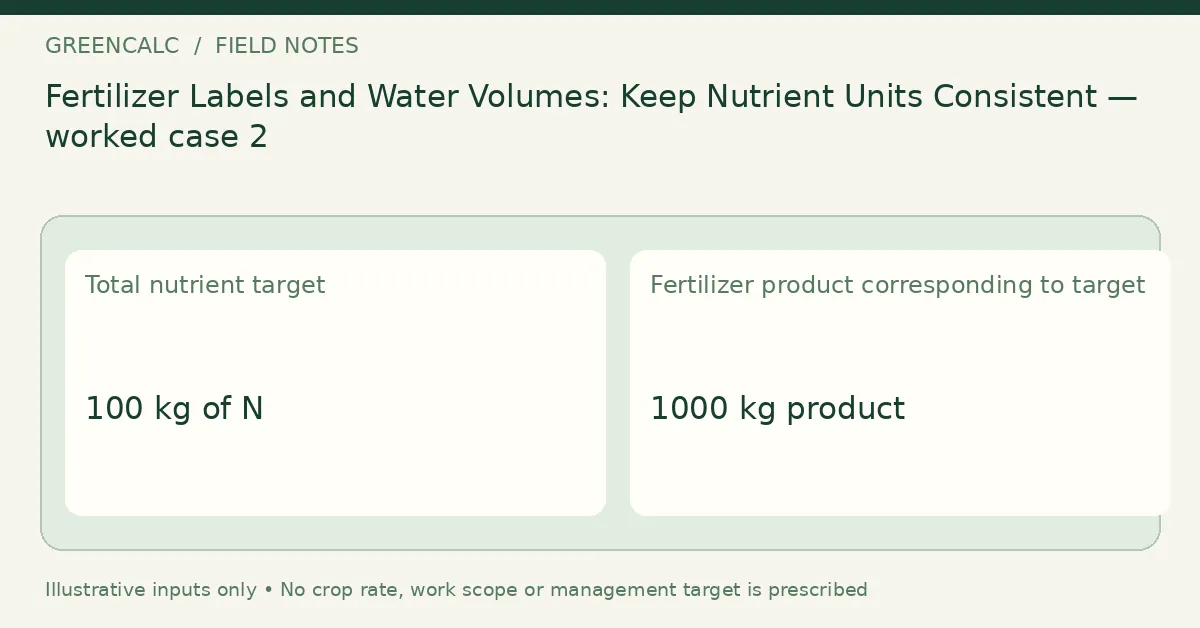
| Total nutrient target | 100 | kg of N |
| Fertilizer product corresponding to target | 1000 | kg product |
Use this comparison to check units, not to decide that the product requiring less mass is always preferable. Cost, other nutrients, formulation and the site plan remain separate considerations. The calculator does not infer them from one percentage.
Worked case 3: Water Soluble Fertilizer Calculator
The final-solution example uses milligrams of elemental nitrogen per liter. The product fraction converts that nitrogen mass into grams of total product. The entered target is an illustration of the units and must not be treated as a general feeding concentration.
Calculate this scenario with Water Soluble Fertilizer Calculator using the following stated inputs.
| Input definition | Illustrative value |
|---|---|
| Plan’s target elemental nitrogen (mg N/L) | 100 |
| Final solution volume (L) | 100 |
| Product nitrogen percentage by mass (%) | 20 |
| Calculated quantity | Result | Unit |
|---|---|---|
| Nitrogen mass at entered target | 10 | g N |
| Fertilizer product at entered N grade | 50 | g product |
A final-solution quantity is not a stock-solution or injector recipe. It also does not establish whether a product dissolves under the actual conditions or whether ingredients are compatible. Those questions require the relevant product and system information.
For concentration-unit relationships, see Horticultural unit and concentration formulas. An equation for a final solution does not supply the appropriate target for a crop.
Worked case 4: Water Soluble Fertilizer Calculator
Holding concentration and product grade constant while halving the final volume creates a direct scale check. The product amount should halve because the desired concentration describes mass per unit of final solution. This does not change the meaning of the target itself.
Calculate this scenario with Water Soluble Fertilizer Calculator using the following stated inputs.
| Input definition | Illustrative value |
|---|---|
| Plan’s target elemental nitrogen (mg N/L) | 100 |
| Final solution volume (L) | 50 |
| Product nitrogen percentage by mass (%) | 20 |
| Calculated quantity | Result | Unit |
|---|---|---|
| Nitrogen mass at entered target | 5 | g N |
| Fertilizer product at entered N grade | 25 | g product |
Check whether the volume in the record is the final solution volume rather than an initial quantity of water or a concentrated stock tank. An unclear volume basis can produce a coherent calculation for the wrong physical quantity.
The Injector calculations are a separate system task treats injector and related system calculations as their own task. Do not infer a stock-system instruction from the final-volume example.
Worked case 5: Fertilizer Calculator
This case deliberately labels both target and grade with the same oxide convention. It does not perform an elemental-phosphorus conversion. Naming the basis in the result helps prevent a correct mass equation from being applied to mismatched chemical definitions.
Calculate this scenario with Fertilizer Calculator using the following stated inputs.
| Input definition | Illustrative value |
|---|---|
| Application area (ha) | 1 |
| Nutrient target from the site plan (kg/ha) | 20 |
| Product percentage for that same nutrient (%) | 10 |
| Target and label nutrient basis | P₂O₅ |
| Calculated quantity | Result | Unit |
|---|---|---|
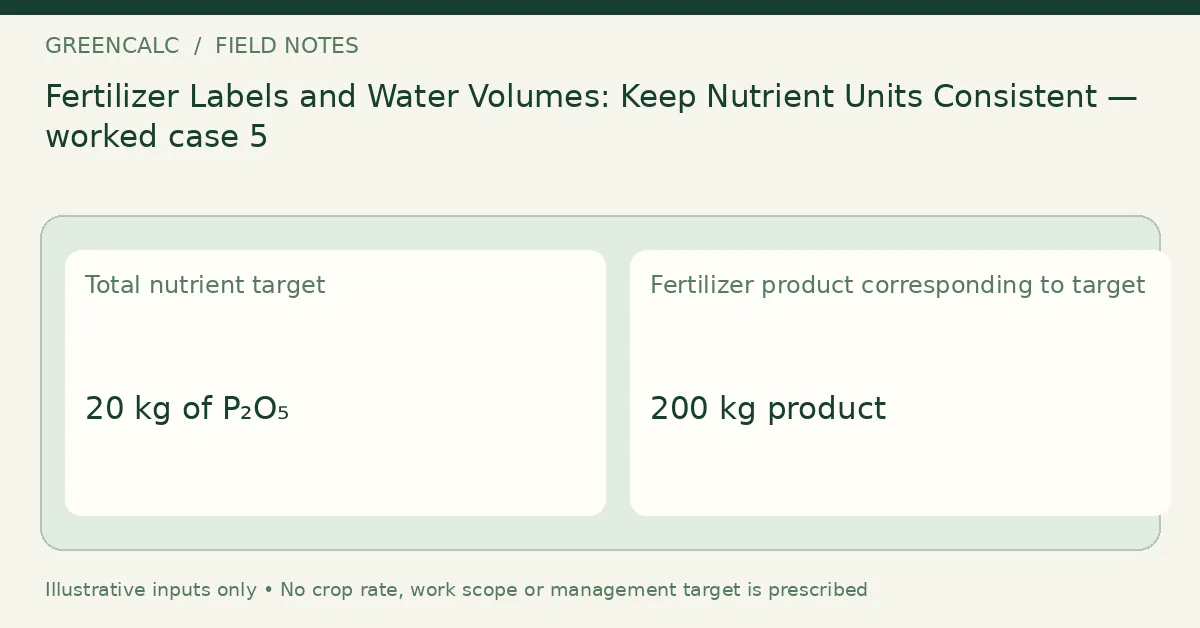
| Total nutrient target | 20 | kg of P₂O₅ |
| Fertilizer product corresponding to target | 200 | kg product |
If a plan gives a different elemental basis, establish the appropriate conversion before entering a target. Do not rename the unit after calculation and assume the number stays valid. Retain the original plan wording and product label for checking.
Worked case 6: Water Potential Calculator
A theoretical water-potential calculation illustrates why solution chemistry is not exhausted by the total fertilizer-product mass. It requires a molar concentration and a particle-factor assumption, not simply the nitrogen concentration entered in the earlier examples.
Calculate this scenario with Water Potential Calculator using the following stated inputs.
| Input definition | Illustrative value |
|---|---|
| Pressure component (MPa) | 0 |
| Matric component (MPa; zero or negative) | 0 |
| Height relative to chosen datum (m) | 0 |
| Ideal solute concentration (mol/L) | 0.05 |
| van ’t Hoff factor for the model | 1 |
| Solution temperature (°C) | 25 |
| Calculated quantity | Result | Unit |
|---|---|---|
| Ideal osmotic component | -0.123948 | MPa |
| Gravitational component | 0 | MPa |
| Sum of entered / modeled components | -0.123948 | MPa |
Do not carry a nitrogen ppm value directly into a molarity field. The solute definition and chemical relationships must first be established. This idealized result is not an electrical-conductivity measurement, a complete nutrient-solution analysis or an irrigation instruction.
Check the other nutrients carried by the chosen product
An illustrative target of fifty kilograms of nitrogen per hectare would correspond to two hundred fifty kilograms per hectare of a product containing twenty percent nitrogen. If that hypothetical product also contains ten percent on a phosphorus-oxide label basis, the same product amount carries twenty-five kilograms per hectare on that label basis. The nitrogen calculation has not decided whether that additional quantity fits the plan.
This example is not a fertilizer recommendation. It shows why solving one nutrient equation does not evaluate the whole product analysis. A different product with the same nitrogen percentage can carry different other nutrients. Keep the complete label with the calculation, and compare the delivered quantities with an appropriate nutrient plan before treating a product mass as a suitable application.
The same distinction appears in a solution calculation. Ten grams of nitrogen can correspond to fifty grams of a twenty-percent-nitrogen product or forty grams of a twenty-five-percent-nitrogen product. Equal target nitrogen does not make the two formulations chemically interchangeable. The arithmetic does not check other ingredients, solubility, water chemistry or compatibility. Those questions require their own information; changing a percentage until the final mass looks convenient does not resolve them.
Check the record before using it elsewhere
Use the following questions to audit this particular workflow. An unanswered question is an input or interpretation issue; it should not be hidden by rounding the output or choosing a result that resembles the expected answer.
- What source supplied the nutrient target?
- Does its basis match the product percentage?
- Is the quantity area-based or volume-based?
- Does the label use N, P₂O₅ or K₂O?
- Is a solution volume final or a separate stock stage?
- Have grams and milligrams been converted explicitly?
- Are compatibility and solubility assessed outside this arithmetic?
- Can another person reproduce the result from the original label and plan?
Retain a revisable measurement sheet
Keep the original observations, the date and the input definitions alongside the calculated result. When a plan changes, record the new scenario separately instead of replacing the evidence behind an earlier estimate. A measured change, a revised assumption and a unit conversion are different events in the record.
Use Fertilizer Calculator for the main quantity in this workflow. For other subjects, return to GreenCalc; for a related calculation, begin with its own units, basis and limitations rather than transferring a result by name alone.
By GreenCalc · Updated 2026-11-06