

Original editorial illustration for Budget Farm Fences and Field Work Without Hiding the Work Scope
Quantities come before a comparable price
A per-meter or per-hour price is meaningful only after the work it covers is defined. Fence strands, openings, gates, terrain, travel, trimming and disposal can sit in different parts of an estimate. A calculator cannot recover a missing scope from a total. Write down the quantity and the included tasks before comparing rates.
Separate material margins from work-time assumptions
A cutting allowance changes a material quantity. Field efficiency changes an effective work rate. Whole-unit rounding changes a purchase count. These are separate operations, and applying all of them indiscriminately can double count the same expected loss. The examples below keep them visible rather than presenting a single unexplained contingency percentage.
Use scenarios instead of invented local rates
All prices and work rates in these examples are illustrative inputs, not current market observations. A budget can be revised using quotes, measured productivity and an actual site plan. It should not be presented as a guaranteed cost, professional valuation or a decision about financing. Currency here is only a label; no exchange-rate or investment model is being applied.
Start in Biology calculators for the field and measurement tools. This workflow also distinguishes questions handled in Construction calculators, Finance calculators. Follow the quantity and its definition rather than assuming that a shared unit makes different models interchangeable.
Worked case 1: Livestock Fence Cost Calculator
The alignment includes gateway openings that do not receive the same fence-run material. Separate fixed items are listed rather than hidden in the run length. Each unit rate must represent the intended design and any included labor or components.
Calculate this scenario with Livestock Fence Cost Calculator using the following stated inputs.
| Input definition | Illustrative value |
|---|---|
| Total boundary / fence alignment (m) | 400 |
| Total gateway openings excluded from fence run (m) | 12 |
| All-strand material cost per fence-run meter | 5 |
| Installation cost per fence-run meter | 3 |
| Material budget allowance (%) | 10 |
| Total gate, end-post and other listed fixed costs | 1000 |
| Currency label (no exchange-rate conversion) | USD |
| Calculated quantity | Result | Unit |
|---|---|---|
| Fence run excluding openings | 388 | m |
| Material budget | 2134 | USD |
| Labor budget | 1164 | USD |
| Total entered-cost estimate | 4298 | USD |
Before revising the total, identify whether a changed number represents more fence, a higher unit price or a different scope. Those are different causes. Adding a generic percentage cannot make two mismatched quotes directly comparable.
Worked case 2: Lawn Mowing Cost Calculator
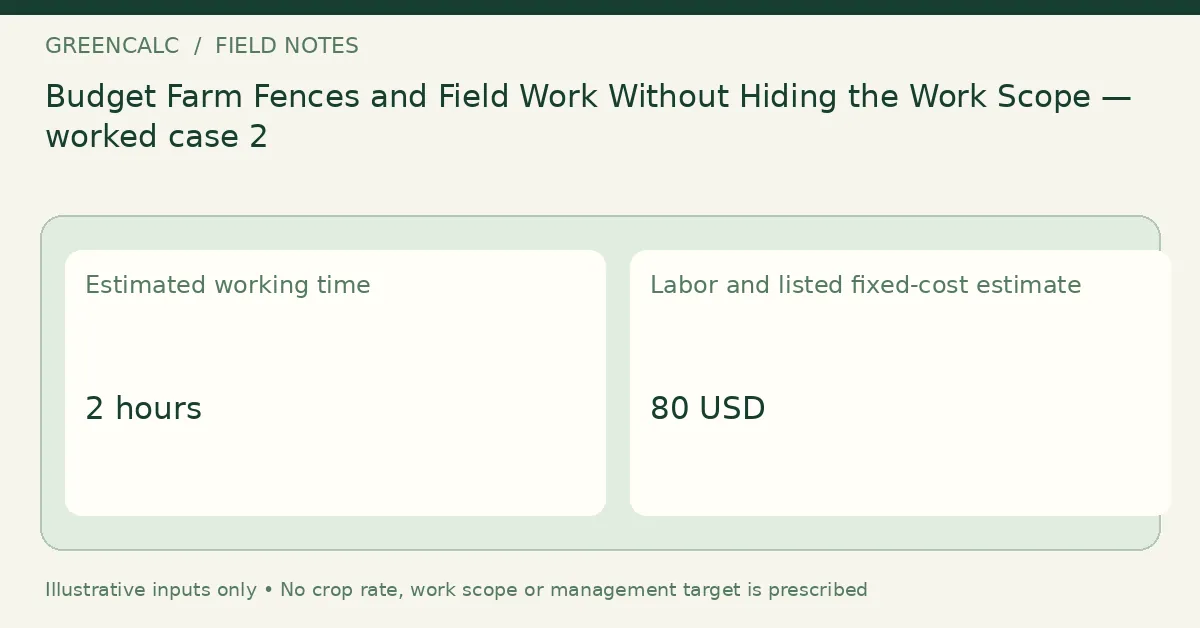
This work-time estimate starts with the area actually cut and an effective productivity rather than an ideal machine capacity. A fixed charge is separate from time-based labor. The example does not infer what travel, edging or disposal the charge covers.
Calculate this scenario with Lawn Mowing Cost Calculator using the following stated inputs.
| Input definition | Illustrative value |
|---|---|
| Actual mowing area (m²) | 1000 |
| Effective mowing productivity (m²/hour) | 500 |
| Entered hourly charge | 30 |
| Other included fixed charges | 20 |
| Currency label (no exchange-rate conversion) | USD |
| Calculated quantity | Result | Unit |
|---|---|---|
| Estimated working time | 2 | hours |
| Labor and listed fixed-cost estimate | 80 | USD |
Use a measured or suitably justified work rate when possible. If the rate already includes typical turning and interruptions, adding the same losses again overstates time. The estimate remains conditional on the stated work conditions and the items actually included.
Worked case 3: Acres Per Hour Calculator
Working width, operating scenario and efficiency produce an effective area rate. A time estimate for a particular area can then use that rate, but the field conditions and the efficiency definition need to stay with it. The calculation does not select a safe speed.
Calculate this scenario with Acres Per Hour Calculator using the following stated inputs.
| Input definition | Illustrative value |
|---|---|
| Effective working width (m) | 3 |
| Assumed operating speed (km/h) | 6 |
| Field efficiency (%) | 75 |
| Calculated quantity | Result | Unit |
|---|---|---|
| Effective field capacity | 1.35 | ha/h |
| Effective acreage capacity | 3.33592 | acres/h |
A theoretical rate and an observed effective rate should not be compared without accounting for their definitions. Treat a rate change as a separate scenario and retain the reason for it, especially when comparing machine capacity with billed work time.
The Effective field-capacity context supports a clearly stated capacity basis. It is not a source of a guaranteed local operating rate for every field.
Worked case 4: Sod Calculator
Material procurement can require a whole number of purchase units even when the underlying quantity is fractional. The allowance and whole-unit rounding are distinct steps. The exact product coverage belongs to the selected roll or slab, not to the word sod alone.
Calculate this scenario with Sod Calculator using the following stated inputs.
| Input definition | Illustrative value |
|---|---|
| Area to cover (m²) | 50 |
| Usable coverage per roll or slab (m²) | 1 |
| Cutting / ordering allowance (%) | 5 |
| Calculated quantity | Result | Unit |
|---|---|---|
| Unrounded material units | 52.5 | |
| Whole units to cover the entered area | 53 |
A different site outline may produce different offcuts without changing the nominal area. Record the basis for the allowance and avoid treating a whole-unit count as proof of coverage in every installation condition.
Whole-product rounding also appears in other materials. From Net Floor Area to Flooring Cartons: Coverage, Allowance and Rounding separates measured area from package coverage. Transfer that arithmetic principle, while retaining the sod supplier’s actual roll coverage and installation requirements.
Worked case 5: Mulch Calculator
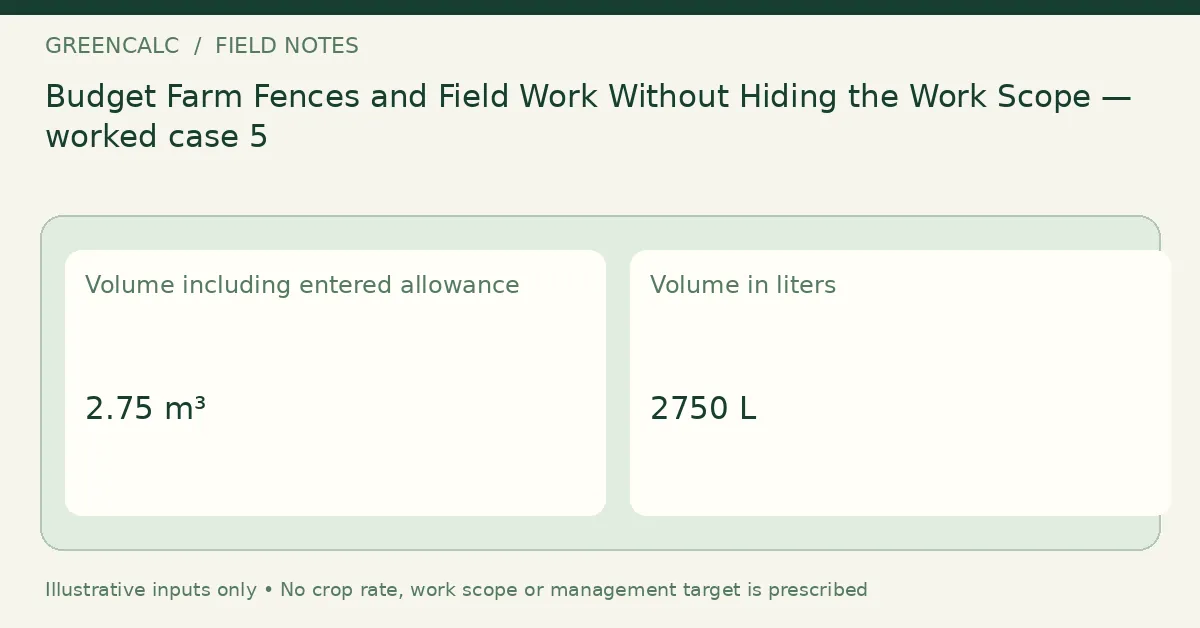
A bulk-material order starts from a chosen area and layer depth. Its volume can be converted into other compatible units for discussing a supplier’s quote. That conversion does not establish density, product grade or the correct depth for the site.
Calculate this scenario with Mulch Calculator using the following stated inputs.
| Input definition | Illustrative value |
|---|---|
| Actual application area (m²) | 50 |
| Chosen layer depth (cm) | 5 |
| Additional volume allowance (%) | 10 |
| Calculated quantity | Result | Unit |
|---|---|---|
| Volume including entered allowance | 2.75 | m³ |
| Volume in liters | 2750 | L |
| Volume in cubic yards | 3.59686 | yd³ |
Compare suppliers on the same loose or settled-volume basis and the same included delivery scope. A volume difference is not automatically a price difference, and a percentage allowance does not resolve an ambiguous product definition.
Worked case 6: Tree Value Calculator
A separate tree-value scenario illustrates why a derived number must retain its valuation purpose. This user-factor model scales a geometric area by a supplied cost and adjustment factors. It does not obtain a market quote or certify a professional appraisal.
Calculate this scenario with Tree Value Calculator using the following stated inputs.
| Input definition | Illustrative value |
|---|---|
| Recorded circular-equivalent trunk diameter (cm) | 30 |
| Externally justified base cost per cm² trunk area | 2 |
| User-selected species factor (%) | 100 |
| User-selected condition factor (%) | 80 |
| User-selected location factor (%) | 80 |
| Currency label (no exchange-rate conversion) | USD |
| Calculated quantity | Result | Unit |
|---|---|---|
| Circular-equivalent trunk area | 706.858 | cm² |
| User-factor valuation scenario | 904.779 | USD |
Do not merge this scenario with construction costs or insurance values without an appropriate external basis. Replacement, sale proceeds and formal appraisal are different questions. Where a documented value matters, use the relevant qualified assessment rather than arithmetic alone.
The Tree measurement and timber-value distinctions helps distinguish measurement and valuation purposes. A user-factor scenario is not a substitute for the appropriate appraisal or sale method.
Reconcile a quoted scope line by line
The fence example leaves three hundred eighty-eight meters of fence run after gateway openings are removed. At the entered material rate and ten-percent material allowance, its material budget is two thousand one hundred thirty-four currency units. The entered labor rate adds one thousand one hundred sixty-four units, and the listed fixed items add one thousand. The resulting total can be traced to those three parts.
A different all-inclusive quote might use a different run length or include gates, posts and terrain work inside its unit rate. Dividing both totals by the same number of meters would not automatically make them comparable. First identify what each quote includes, then normalize compatible quantities. Do not remove a line from one quote merely because another quote does not display it separately.
The mowing example follows the same principle in time units: two modeled working hours at the entered hourly rate plus a listed fixed charge. It does not reveal whether travel or edge work is already included. These examples organize assumptions; they are not local prices or advice about which contractor to choose. A difference in two totals is useful only after the underlying work and measurement bases have been reconciled.
Check the record before using it elsewhere
Use the following questions to audit this particular workflow. An unanswered question is an input or interpretation issue; it should not be hidden by rounding the output or choosing a result that resembles the expected answer.
- What tasks and materials does each unit rate include?
- Are gateway lengths removed from the fence run?
- Are fixed items counted once?
- Does productivity already include turning or interruptions?
- Is a material allowance separate from whole-unit rounding?
- Are prices quotes, observations or illustrations?
- Is a value being used for the right appraisal or budget purpose?
- Which unlisted site condition could materially change the estimate?
Retain a revisable measurement sheet
Keep the original observations, the date and the input definitions alongside the calculated result. When a plan changes, record the new scenario separately instead of replacing the evidence behind an earlier estimate. A measured change, a revised assumption and a unit conversion are different events in the record.
Use Livestock Fence Cost Calculator for the main quantity in this workflow. For other subjects, return to GreenCalc; for a related calculation, begin with its own units, basis and limitations rather than transferring a result by name alone.
By GreenCalc · Updated 2026-11-06