
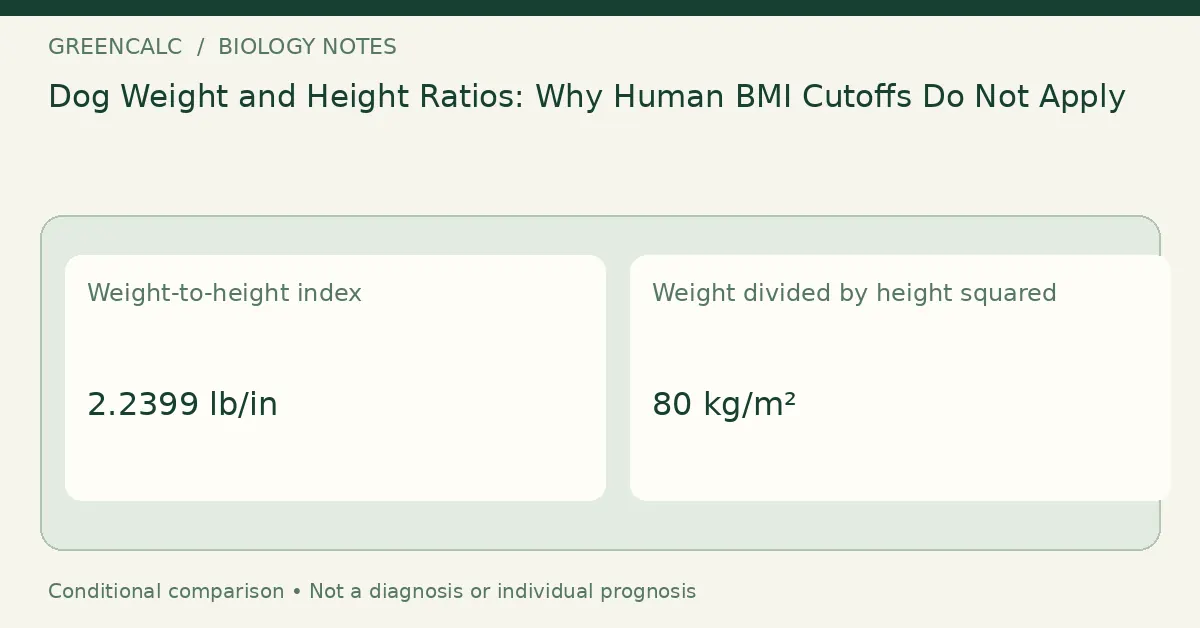
Original instructional diagram for Dog Weight and Height Ratios: Why Human BMI Cutoffs Do Not Apply. Values, when shown, are illustrative; clinical images do not recommend a dose.
Do not import human categories
Dogs differ widely in size and conformation. A numerical ratio of body weight to height is descriptive, but the familiar human BMI cutoffs do not establish canine body condition. This tool therefore reports the ratios without assigning healthy or obese categories.
Use Dog BMI Calculator to work through these inputs while keeping the displayed assumptions in view.
Keep measurements consistent over time
Use the same standing-height landmark and reliable weight measurements when making a record. A changing ratio may reflect several factors and does not establish their cause. Veterinary body-condition and muscle-condition assessments answer different questions from this arithmetic.
This question belongs to the Dog calculators group within Biology calculators.
Read the calculation on its stated basis
Descriptive ratios: pounds ÷ height in inches, and kg ÷ height in meters squared.
No universal healthy canine BMI range is supplied. Body-condition and muscle-condition assessment are different tasks.
Retain the input definitions and units with the result. A later comparison should use the same basis; a change in method is a new scenario, not simply a more precise version of the old number.
Keep related questions separate
Dog Nutrition Calculator addresses a related part of the measurement or interpretation task. Check its own method before carrying a value from one tool to the other.
For a related perspective, read Dog Energy Planning: Keep the Resting Reference Separate from the Feeding Target.
For tools in other subjects, return to GreenCalc. Keep the calculator result with its assumptions rather than using a link or a matching unit as evidence that two models are interchangeable.
By GreenCalc · Updated 2026-11-05