
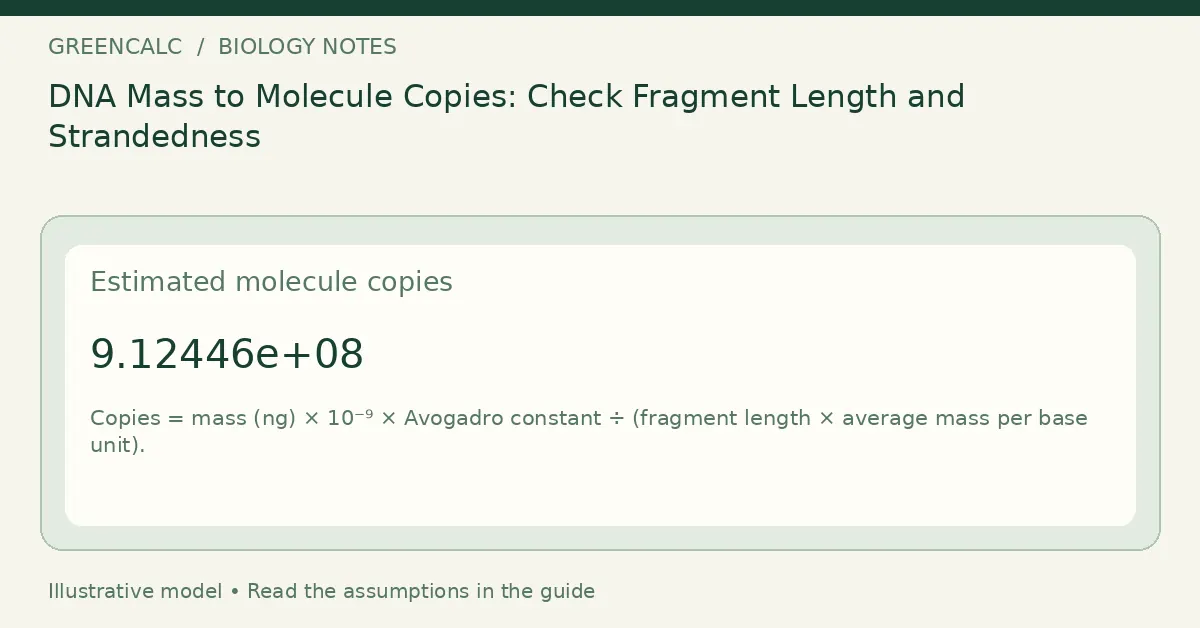
Original instructional diagram for DNA Mass to Molecule Copies: Check Fragment Length and Strandedness. Values, when shown, are illustrative; clinical images do not recommend a dose.
Identify which fragment the mass describes
The entered mass should refer to the specified DNA fragment. If the sample contains multiple lengths or substantial contaminants, assigning the total measured mass to one length can overstate that fragment’s molecule count. Keep the measurement and the fragment definition together.
Use DNA Copy Number Calculator to work through these inputs while keeping the displayed assumptions in view.
Check base pairs versus nucleotides
Double-stranded base pairs and single-stranded nucleotides use different approximate average molecular masses. A length copied without its strandedness can therefore change the count substantially. The result remains a model-based estimate because sequence composition and measurement uncertainty are not fully represented.
This question belongs to the Genetics calculators group within Biology calculators.
Read the calculation on its stated basis
Copies = mass (ng) × 10⁻⁹ × Avogadro constant ÷ (fragment length × average mass per base unit).
Retain the input definitions and units with the result. A later comparison should use the same basis; a change in method is a new scenario, not simply a more precise version of the old number.
Keep related questions separate
DNA Concentration Calculator addresses a related part of the measurement or interpretation task. Check its own method before carrying a value from one tool to the other.
For a related perspective, read A260 Measurements: Avoid Applying Dilution or Path Correction Twice.
For tools in other subjects, return to GreenCalc. Keep the calculator result with its assumptions rather than using a link or a matching unit as evidence that two models are interchangeable.
By GreenCalc · Updated 2026-11-05